





















Deerfield, New Hampshire
Ninety-two hundredths of an inch.
That’s how much rain fell on Monday, August 3, in Deerfield, New Hampshire. The driving rain was great for local gardens and lawns but not so great for dealers and attendees of the one-day Deerfield Antique Show promoted by Gurley Antique Shows, run by the brother-and-sister team of Joshua and Rachel Gurley. Before the show opened, cell phones buzzed in unison as flash flood warnings from the National Weather Service were broadcast.
It was pouring buckets when the show opened at 9 a.m., but dealers and collectors are a passionate, hearty, and well-prepared bunch. Umbrellas, slickers, and rubber boots were put to use because a little rain—or in this case a lot of rain—wasn’t about to stop many from shopping at a show with approximately 75 dealers. There was too much to see, to buy, and so much with which to be enthralled. Since the show is for one day only, buyers had to make hay even though the sun decidedly did not shine.
The rain affected few of the dealers and their merchandise. A vast majority are in three buildings on the fairgrounds, so once inside it was safe and dry shopping. The outside dealers—safely in their own tents—had to wait out the rain, which stopped falling by around 10 a.m., one hour into the show.
“I did the math for Deerfield, and it was pretty good,” said Rachel.
“I was surprised by the number of people that came,” added Joshua. “It was off but it was still a lot of people. Under the circumstances, we’re calling it a win.”
Deerfield was the second show of New Hampshire Antiques Week to open, and despite the adverse conditions, it proved that when it comes to art and antiques, there’s a strong hunger to find antiques.
For more information, contact Gurley Antique Shows at (207) 396-4255 or check the website (www.gurleyantiqueshows.com).
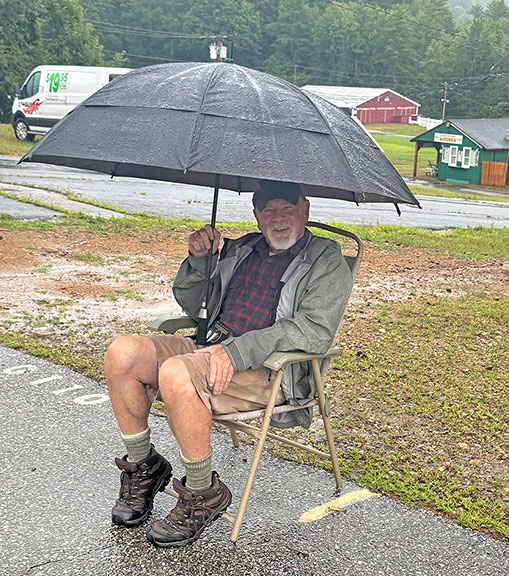
Collector Scott Cook braved the pouring rain and was first in line, already settled at 7:15 a.m., well before the 9 a.m. opening. He was in good spirits but did say his boots had gotten wet.
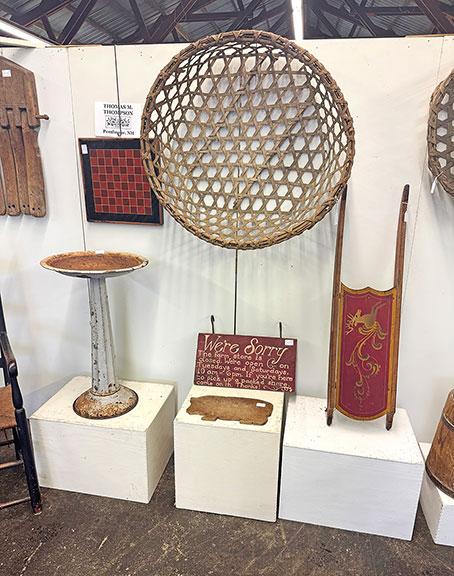
Thomas M. Thompson of Pembroke, New Hampshire, offered a large cheese basket for $450, a farm stand sign for $195, a pig cutting board for $45, a tin birdbath for $225 (It went home with this reporter several hours after the show had opened), a game board for $495, and a decorated sled for $395.
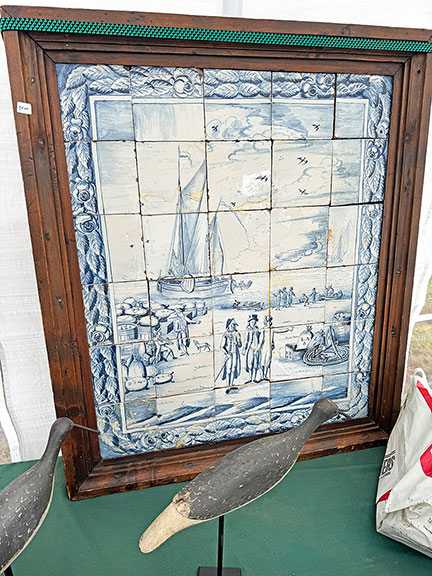
The dockside image constructed of 30 delft tiles was $9500 from Hilary Nolan of Falmouth, Massachusetts.
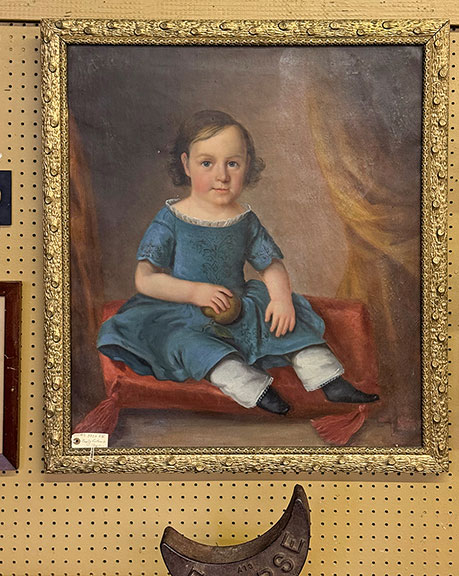
This early portrait of a child with a ball was $2500 from Gurley Antiques, Scarborough, Maine.
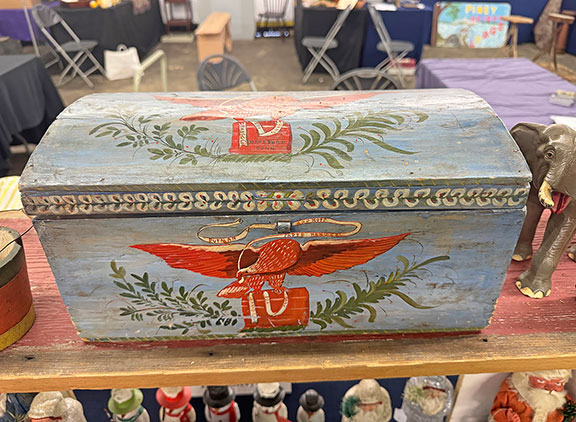
The paint-decorated dome-top box by band box makers Putnam and Hoff of Hartford, Connecticut, features an eagle with a banner reading “Putnam and Hoff Paper Hangers.” Erb’s Antiques, Lancaster, Pennsylvania, tagged it $2995.
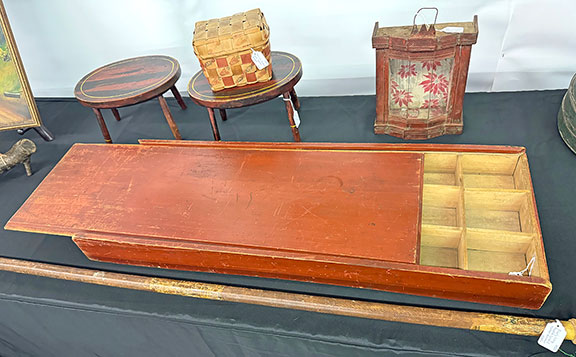
This large 19th-century slide-lid box seed box in original red paint was $495 from Ken and Robin Pike of Nashua, New Hampshire. In an email, the Pikes wrote, “Despite the torrential rains, we had a very good show. Sales were very close to past years, which was our goal. We sold twenty items. We felt the gate was lighter because of the weather, but it didn’t matter as far as we were concerned. The serious buyers still showed up.”
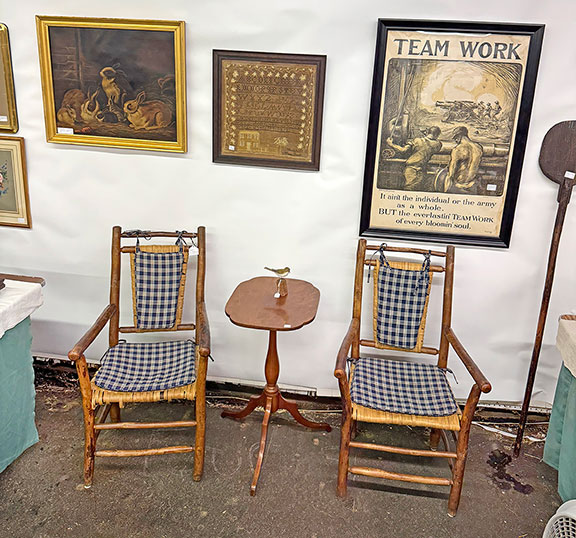
Michael and Lucinda Seward of Pittsford, Vermont, offered a pair of Adirondack armchairs for $225; a bird carving by Sandwich, Massachusetts, woodcarver Philip “Peter” Peltz (1915-2001) was $345; the early 19th-century cherry stand was $375, the 19th-century oil on canvas of bunnies, circa 1870, was $975; the 1830 needlework by Maria Bacon was $950; and the rare World War I “Team Work” poster by Burleigh Litho. Co., Troy, New York, was $950.
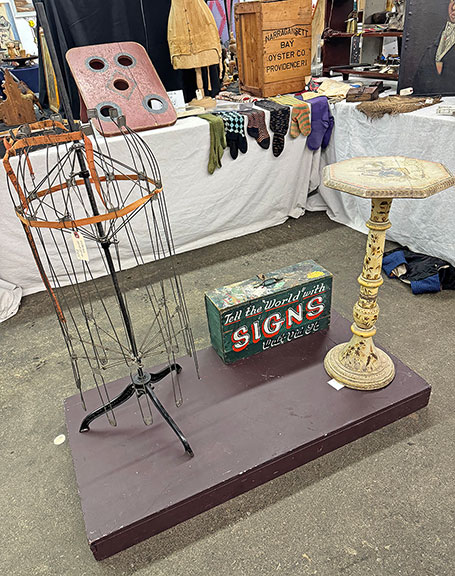
The Victorian skirt form was tagged $375; the sign painter’s box, “Tell the ‘World’ with Signs,” was $425; and the schoolgirl-decorated stand was $1800; all from Cottage+Camp, Millerton, New York.
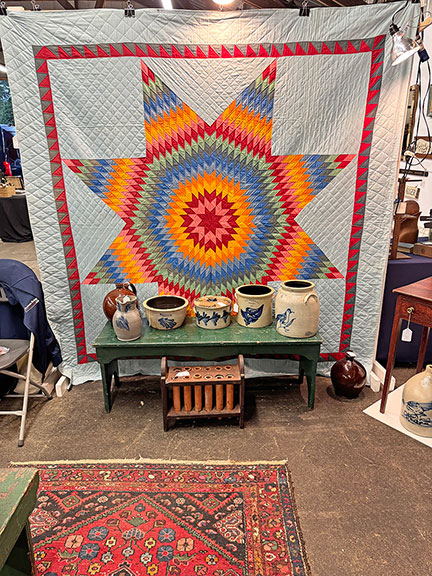
The Star of Bethlehem quilt, Pennsylvania, circa 1890, 84" x 84", was $595 from American Antiques, Ralph Ridolfino, Hammondsport, New York. From left: the redware jug with four incised bands on the collar, circa 1830, was $375; the stoneware pitcher with three large tobacco leaves was $695; Cowden and Wilcox bowl with a cobalt tulip, $350; stoneware cake crock with lid, eight deep blue blossoms, signed “RCR Phila,” $1250; stoneware one-and-a-half-gallon crock by R. White & Son, Utica, New York, $365; and a two-gallon stoneware crock by White’s of Utica, New York, was $625. The candle mold in front, 1825-54, has 12 lead glazed redware tubes, each stamped by A. Wilcox of the Alvin Wilcox Pottery in Bloomfield Township, Ontario County, New York, and priced at $1950. According to Ridolfino, “The crowd last year seemed quite a bit larger than this year’s. My sales were way down this year. The opening crowd seemed a bit angry or frustrated because of all the rain. Folks around me in my building did not do well.”
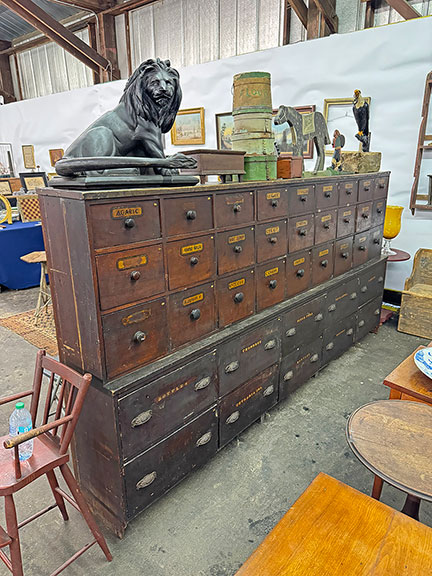
Not something to buy if you’re driving a Subaru. The 10ʹ long, 5ʹ tall one-piece apothecary was $15,500 from Ian McKelvey of Windham, Connecticut.
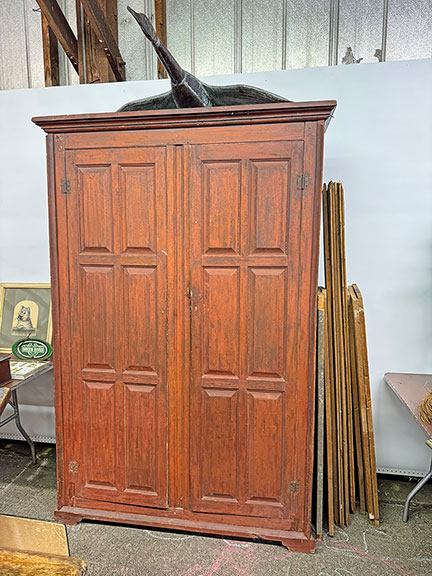
This large Canadian cupboard, dry-scraped down to red, 1780-90, was $2500 from Josh Farrin of Randolph, Maine.
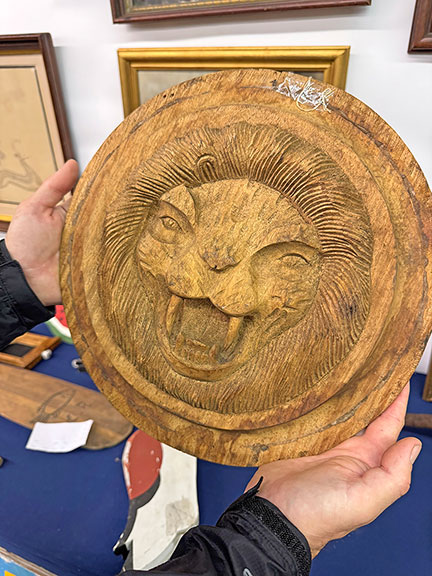
The double-sided carved wildcat or lion panel, 1930s, possibly from a door, was $250 from Evan Grant of Bremen, Maine.
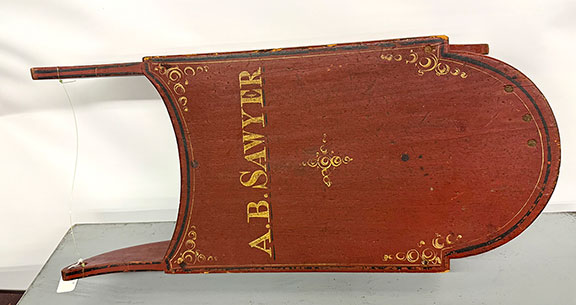
The A.B. Sawyer painted sled is a Maine piece and was $850 from Martha Boynton of Townsend, Massachusetts. It was once in the collection of her mother, Pam Boynton.
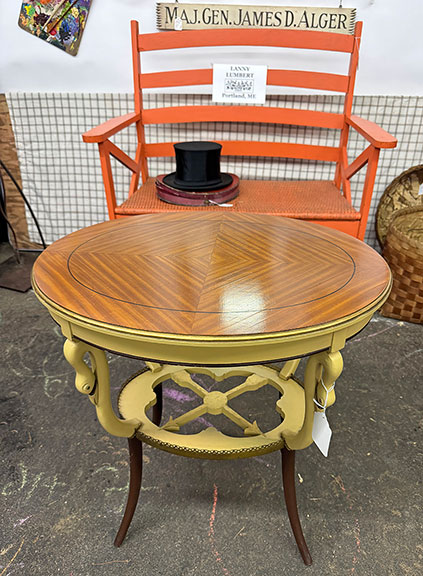
The circa 1930 table with mahogany veneer marquetry, a brass rail, and swan’s head decoration was $325 from Lanny Lumbert of Double LL Antiques & Collectibles, Portland, Maine. The German collapsible silk top hat with box, early 20th century, was $175; the bench in salmon-colored paint was $250; and the sign “Maj. Gen. James D. Alger,” who was known as “Gentleman Jim” when he was at West Point (Class of 1935), was $60. Alger attended Gould Academy in Bethel, Maine. The bench sold.
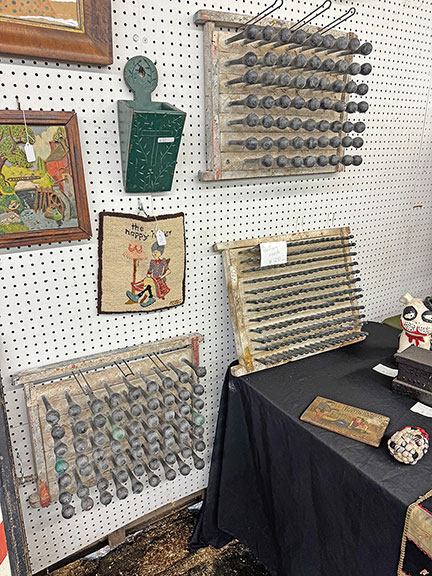
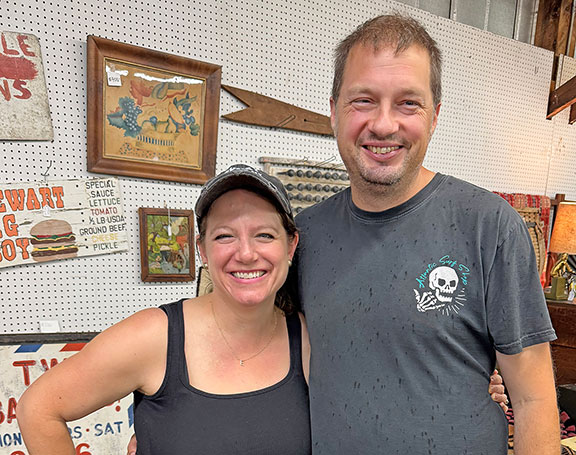
Dealers Matt Grieg and Emily Brandenburg tied the knot on June 6. Emily’s hat reads “Sorry about my husband.” The newly hitched couple from Milton, Delaware, offered several balloon molds from the early 20th century tagged $200 each.
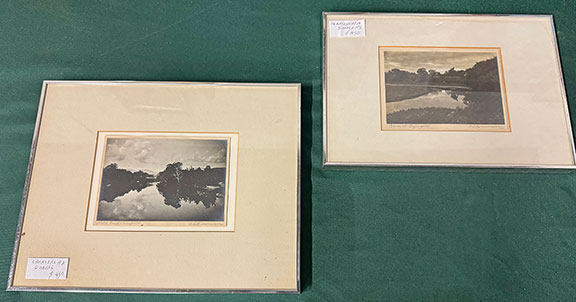
Two photographs by Maine photographer Chansonetta Stanley Emmons (1858-1937) were $450 each from Emily Lampert of Salisbury, Massachusetts. The photographs are titled Mill Pond, Kingfield and River at Ogunquit. Emmons’ identical twin brothers, Freelan Oscar Stanley and Francis Edgar Stanley, invented the Stanley Steamer automobile.
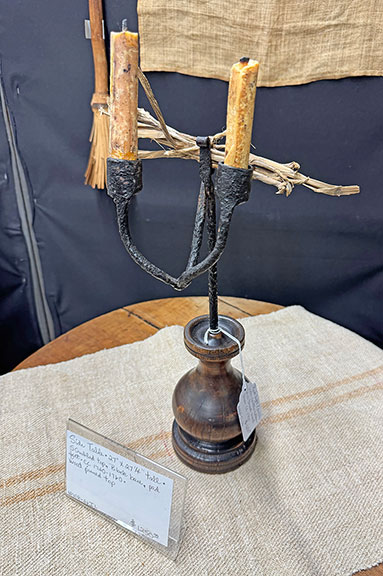
This rushlight/double iron candleholder in a turned wood base, circa 1700, was $1650 from Mary DeBuhr of Downers Grove, Illinois. DeBuhr said, “I was pleased and grateful for Deerfield this year. It’s a show that offers something for everyone in three buildings plus many outdoor tents. A great big thank you to everyone who attended, in spite of the weather forecast. Thank goodness the rain stopped during most of the show…. I was happy with my sales which were about the same as last year and much, much better than 2023 and 2024. Perhaps because of the weather I wrote sales receipts throughout the day, not just in the morning. Because I live over a thousand miles away it’s also a welcome social event for me, one I always look forward to…. The antique market truly is alive and well.”
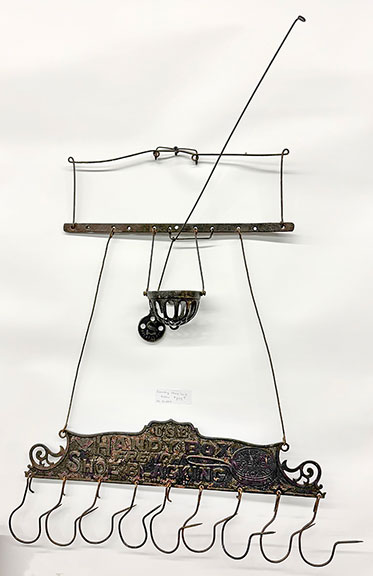
The country store sack holder, marked “Use Handy Box French Show Blacking,” was $895 from Mr. and Mrs. Smith Antiques, Harlan, Iowa.
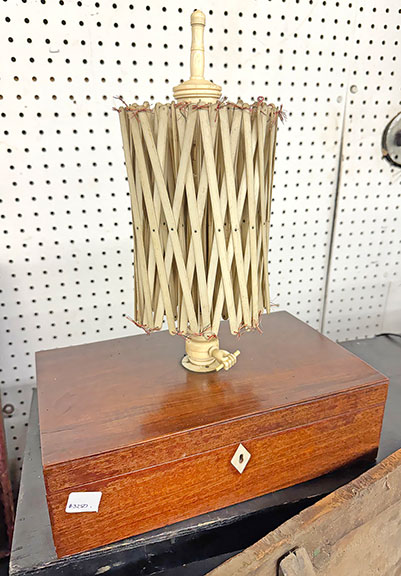
This whalebone swift with box dates from the 19th century and was $3250 from Michael Malloy of Phippsburg, Maine.
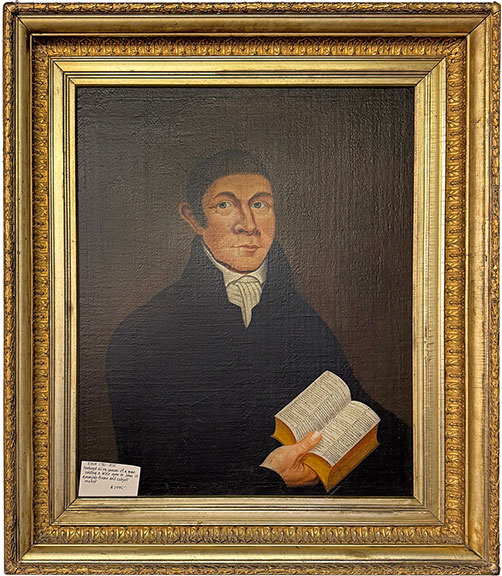
The 1780-1820 oil on canvas portrait of a man holding a Bible open to John 14 was $2495 from Rick Fuller of South Royalton, Vermont.
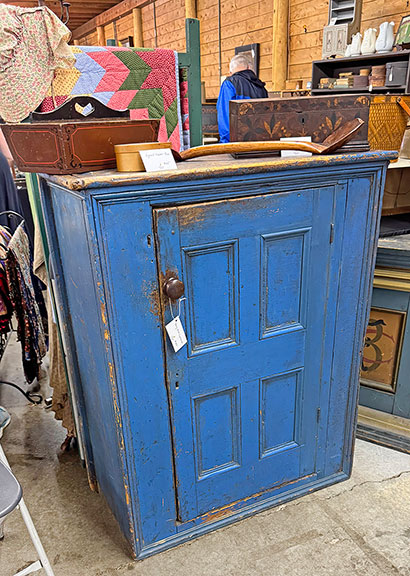
The early blue cupboard from Dean Witham of Red Clover Antiques, Westford, Vermont, who shared a booth with Cooper O’Connell, was $745. The signed Shaker box on it was $195; the knife box in original paint, $150; the marquetry document box, $450. We missed the price of the double-sided scoop.
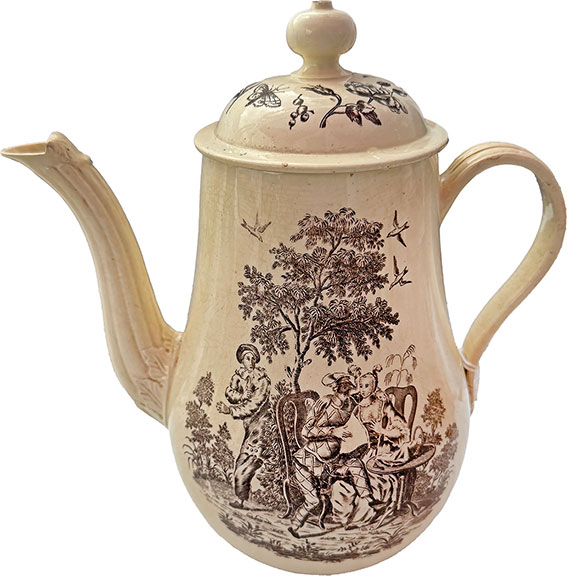
This creamware strapped-handle teapot featuring a tea party scene with a voyeur, 1790-1800, was $215 from Gregory Lovell Antiques, Hyde Park, Massachusetts.
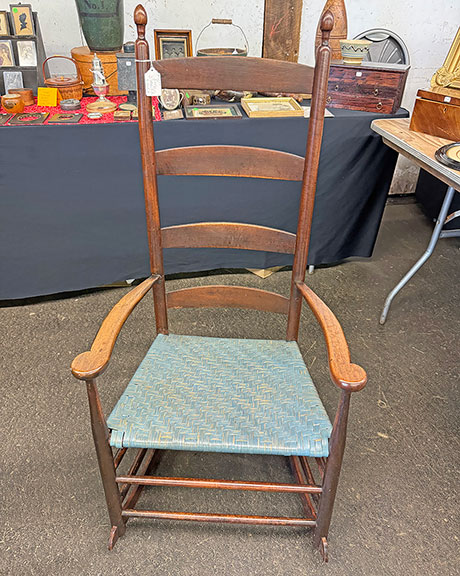
This Shaker rocking chair appears in Shaker Style (1995) by John S. Bowman. Steve Evans of Maynard, Massachusetts, asked $1250 for it.
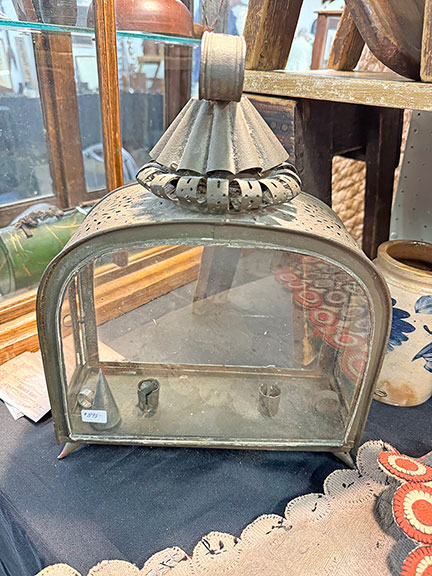
The tin and glass double-candle lantern, probably Continental, early to mid-19th century, from Colleen B. Alpers of Cedar Rapids, Iowa was $895. Alpers said she had never seen another like it. The snuffer is a replacement.
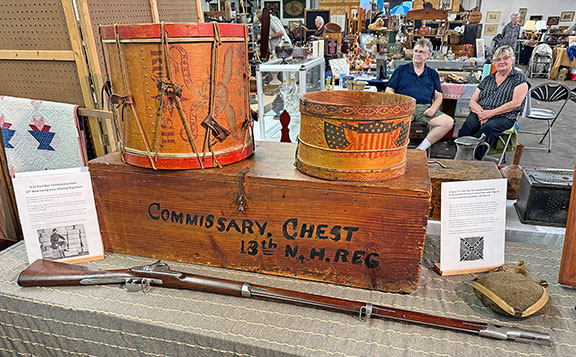
At left, an American militia drum, circa 1840, with an eagle, “North America,” and “Rush,” was probably the militia company’s town. The omission of an olive branch suggests an early Mexican War date, according to dealers Todd and Richard Dean of Edmond, Oklahoma. It was $1500. The 1842 Springfield musket was $3500. The commissary chest from the 13th New Hampshire Regiment was $300; the smooth-side canteen, captured from the Confederates in the Civil War, and reissued, still with its CSA stencil on the front, was $550. The toy drum was $450.
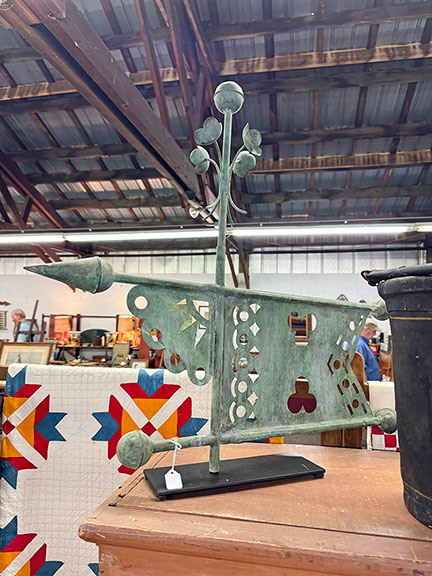
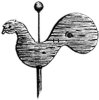
The banner weathervane was $625 from Suzanne Baker Antiques of Westville, Indiana.
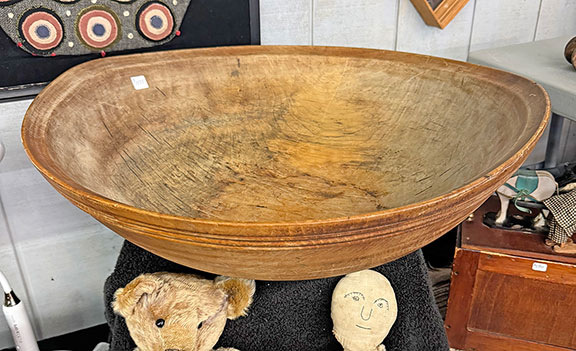
The large wooden bowl with no cracks, circa 1840, was $1575 from Elaine Fleming of Middleboro, Massachusetts.
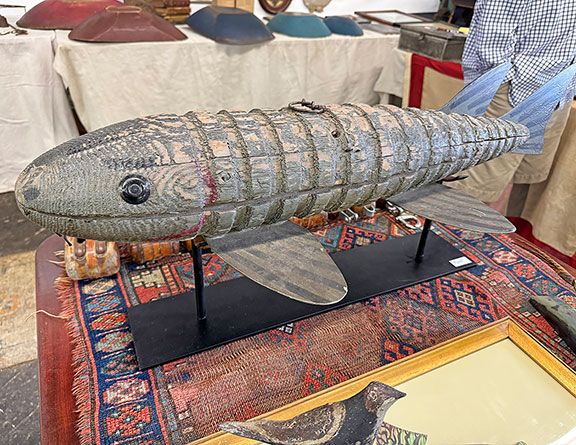
This sturgeon ice fishing decoy trade sign with a ribbed body, marked “Cund,” early 20th century, was $2850 from Firehouse Antiques, located at Buckley Mills in Rising Sun, Maryland. Owner Paul Thien said, “We were not affected by the rain. Sales were decent but many fabulous items were passed on due to pricing—perhaps a sign of the times…. Overall, the Gurleys do a great job.”
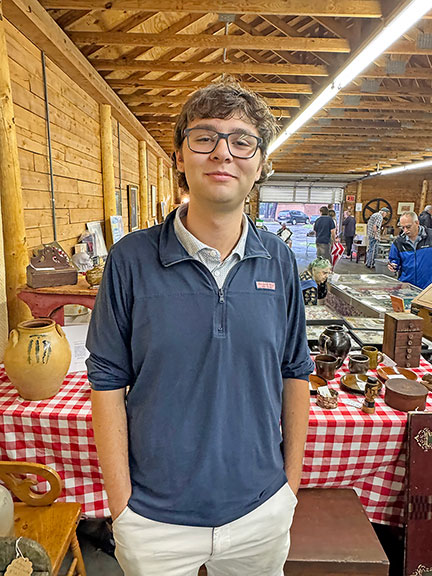
Cooper O’Connell is the owner of Gilded Goose Antiques in St. Albans, Vermont. He is 19 years old and a full-time honors student at the University of Vermont. Deerfield was his third show.
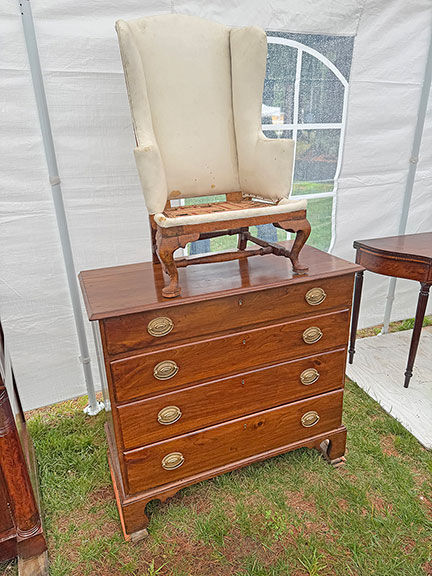
Jon Rider of J.E. Rider Antiques, Essex, Massachusetts, was outside, safely walled in a tent. He asked $2400 for the circa 1790 Connecticut cherry chest, and $1400 for the miniature wing chair.
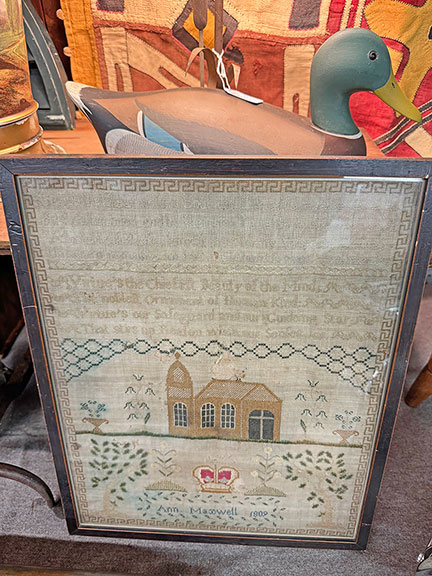
Christopher Stanley of Bremen, Maine, offered a dated 1809 sampler by Ann Maxwell for $350.
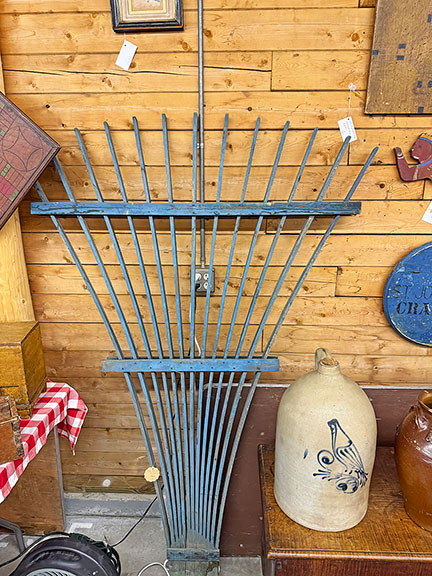
This late 19th-/early 20th-century trellis in its original blue paint was $800 from Cooper O’Connell of Gilded Goose Antiques, St. Albans, Vermont. The five-gallon stoneware jug depicting a bird with a large chest was $500.
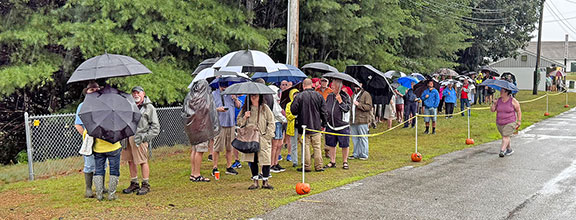
A hearty bunch of buyers, umbrellas deployed, braved the pouring rain to get first crack at the dealers’ offerings.
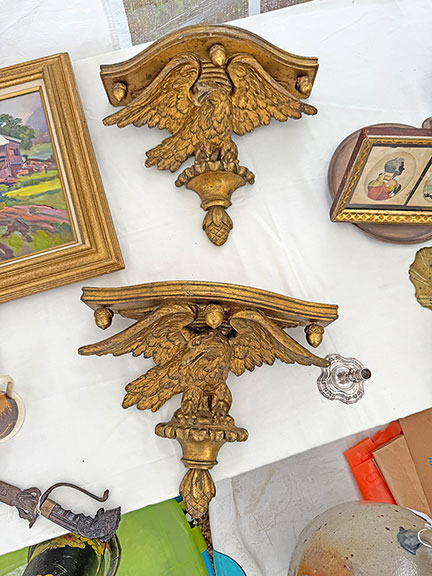
These Centennial eagle brackets, constructed of plaster, were $750 from Thomas Moser of Gray, Maine.
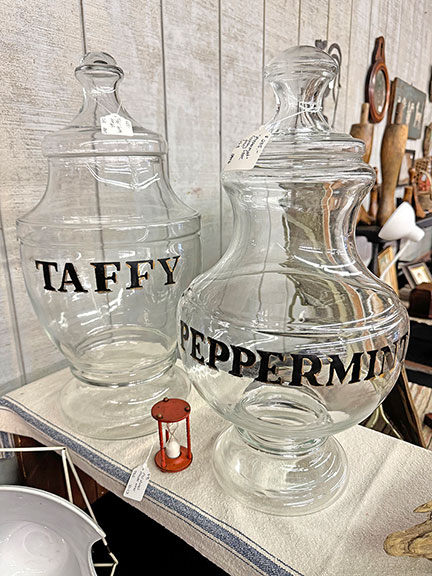
The glass taffy country store jar was $285, as was the peppermint jar, both from Days Gone By Antiques & Interiors of Royalston, Massachusetts.
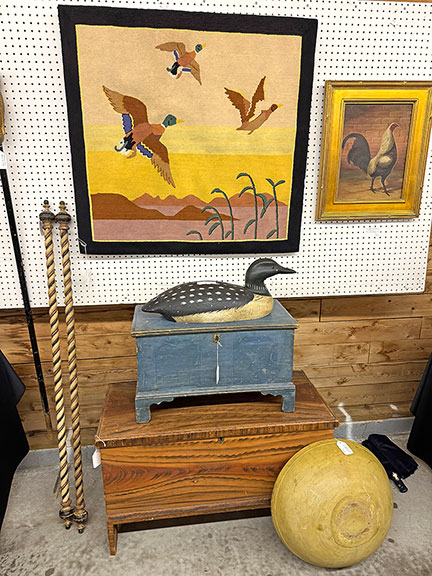
This colorful Grenfell weaving of ducks in flight was tagged $950 by Nancy and Craig Cheney of Mansfield, Ohio. The carved and painted loon, signed “JB,” was $495; the small blue painted blanket chest was $2100; the larger blanket chest with original paint decoration was $950; and the 19" diameter wooden bowl in mustard paint was $675. According to the couple, “Overall, our show was not as successful as in previous years; several people who have bought from us before at Deerfield either didn’t attend this year or didn’t find their heart’s desire if they did attend, plus the weather did not help. We felt that the general quality of merchandise at the show was not as high as in previous years, but we all know that finding great things with profit left in them is getting harder and harder for all dealers. The Gurleys did their usual great job as promoters; any issues or problems were taken care of quickly and professionally, so no complaints there. Now if they could just control the weather!”
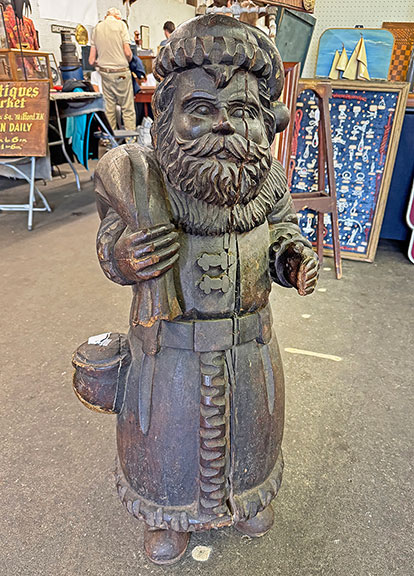
This 1920s Santa Claus papier-mâché mold from Bittner & Bock, Medford, New Jersey, was $2100, and it sold shortly after we took the photo. “Overall, we were pleased with the show. Our first apprehension for a successful show was gas prices. We were concerned that the cost to travel might hold some people back. During this show we normally meet and talk with people from all parts of the country. We noticed this year that it was more Northeastern shoppers. Then the rain—when the alerts started going off, we felt that it was a bad omen. In spite of the rain, the diehards came, shopped and spent money. I do think the two factors mentioned did make for a lighter crowd but we still did well enough to make the trip from New Jersey worthwhile. We were down about twenty percent from last year but that can happen under any circumstances. We think it’s a no frills, well run, fun show to do and wouldn’t miss it.”
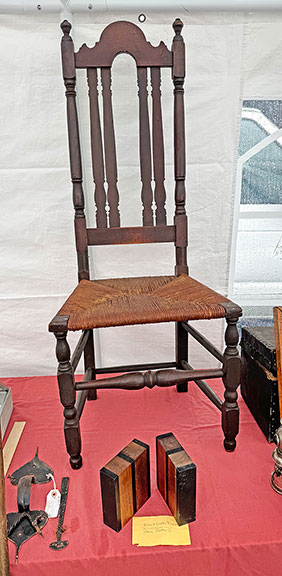
The Duxbury chair in original paint, branded “Livermore” was $600 from Richard Kenney of Exeter, New Hampshire. The early Paul Evans bookends in front were $300.
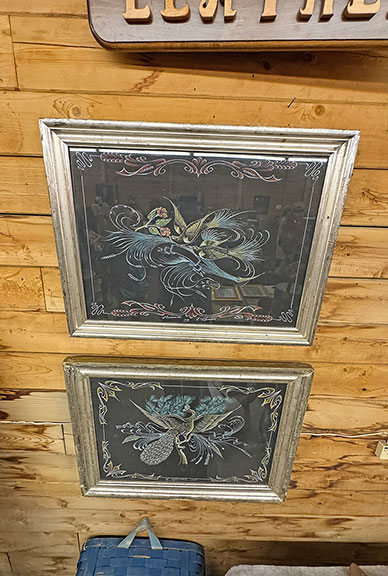
The near pair of calligraphy paintings in colored chalk and watercolor are both signed in the bottom center. The example with doves (top) is signed, “Penmanship E. Bambeck 1876 1880,” and the peacock is signed the same but is missing “penmanship.” Sold as a pair, David Weiss of Sheffield, Massachusetts, asked $2500. Weiss said “My sales were few but one was a very decent sale. I felt that the rain was really a hindrance. I didn’t see many faces that I normally do at shows and particularly those who are interested in my style of merchandise…. Compared to last year, it was disappointing, but I think the rain was the culprit. Win some, lose some, I guess.”
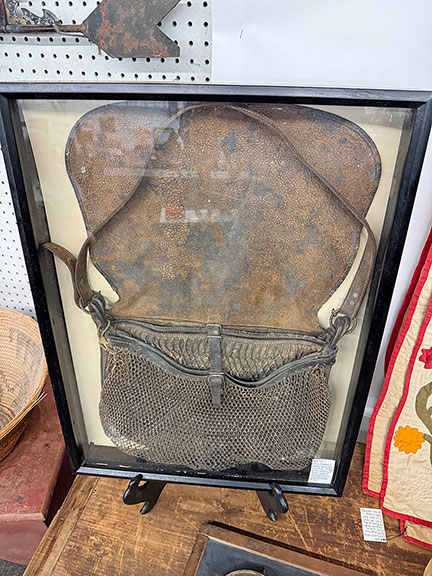
This framed early leather and netting game bag, 11" x 15¼", was $535 from Jean Tudhope of Middlebury, Vermont. Tudhope also had a pair of handmade crossed ski andirons, priced at $695, made by an artisan in St. Johnsbury, Vermont.
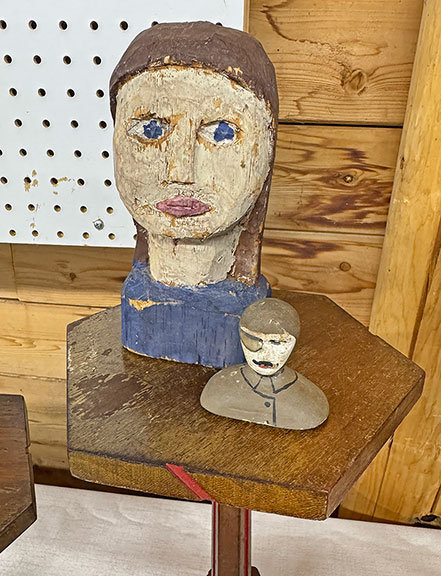
The large carved head came from the Vermont area, dating to the 1950s-60s, and was $135 from Thais Glazman of Child of Folk, New York City. The World War I-era carving—he was missing one half of his goggles—was $65.
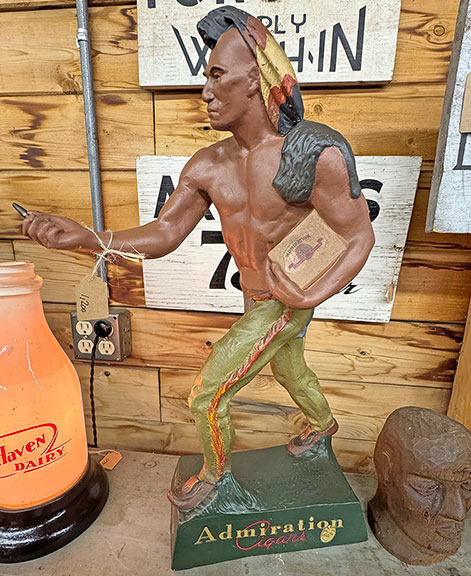
Admiration Cigars countertop figure, $1200, from Robert Callen Antiques, Lexington, Virginia.

Originally published in the October 2026 issue of Maine Antique Digest. © 2026 Maine Antique Digest