






















Doyle, Boston, Massachusetts
Photos courtesy Doyle
The Boston Collects auction at Doyle Auctions, held in the Back Bay gallery, on September 25, brought fine silver to market, and buyers were gratified, bidding many lots well past estimates. Fine silver was consistently strong, while a couple of lots deaccessioned by the Museum of Fine Arts, Boston, delivered the same strong results.
A cache of lover’s eye portrait jewelry from a collection included some prime examples of the miniature art that swept England between 1790 and 1820. A painted eye portrait of the beloved was featured on lockets, brooches, rings, and even small boxes to express affection for a beloved or a secret lover. The Prince of Wales, the future George IV, commissioned one of his own that he sent with a marriage proposal to his lover Maria Fitzherbert. Fitzherbert was unsuitable as a wife because she was Catholic, twice widowed, and some years older than the prince. They had a secret, illegal marriage, but he later officially married Princess Caroline of Brunswick. With the secret marriage, a portrait of Fitzherbert’s eye was also painted and placed in a locket for George.
For more information, check the website (www.Doyle.com) or call (617) 894-8115. All prices quoted reflect the buyer’s premium.
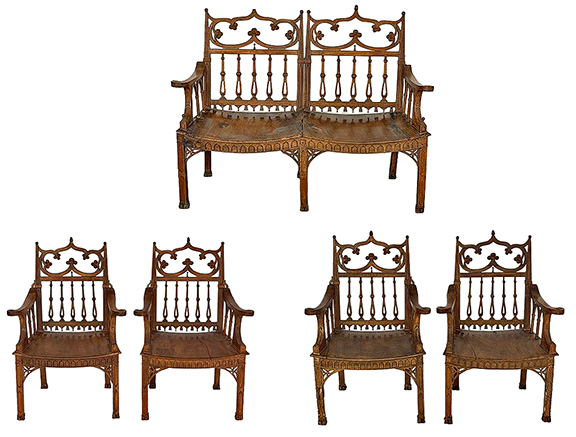
This set of four circa 1765 George III Neo-Gothic walnut armchairs, 46" x 31" x 23", and a settee, 46¼" x 60" x 23½", en suite, attracted strong international bidding and sold for $57,600 (est. $4000/6000). They were deaccessioned by the Museum of Fine Arts, Boston (MFA) for the benefit of the collection. The five pieces came from a group of ten examples, and the MFA retained five. This set has likely gone overseas.
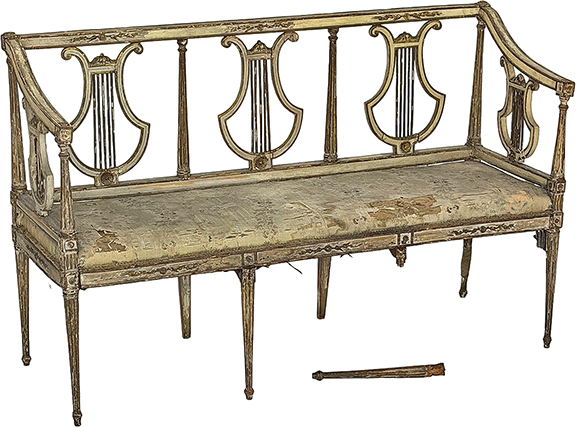
This late 18th-century Italian triple-lyre-back settee, 35½" x 55½" x 20", in white paint and gilt, was estimated at $600/800 and brought $2048. In need of restoration, it will shine when that is completed. It was deaccessioned by the MFA, Boston, for the benefit of the collections. It had been given to the museum by Mrs. Walter Scott Fitz.
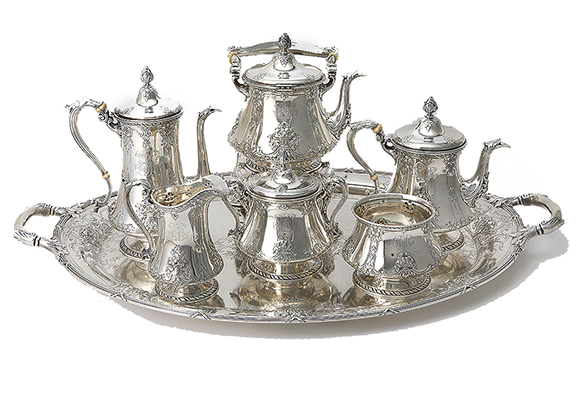
This Gorham sterling tea and coffee service, 1916, includes a teapot, 10¾" tall coffeepot, kettle on stand, cream jug, covered sugar bowl, and two-handled tray. The set, 311 ounces, was estimated at $6000/8000 and sold for $16,640. It came from the estate of Diane A. Nixon, lifelong New Yorker, major collector, inveterate traveler, and philanthropist.
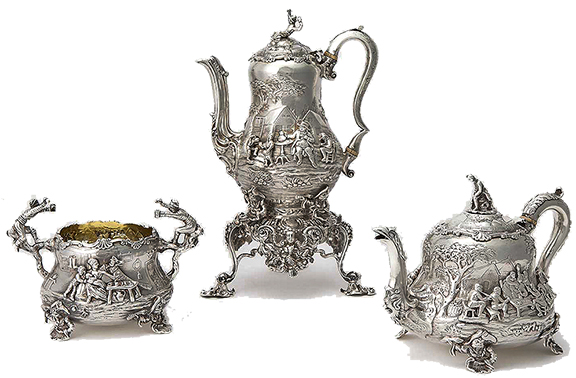
This Victorian sterling partial tea and coffee service was made by Edward Farrell (c. 1779-1850), London, in 1837 in the Teniers pattern. It includes a teapot, coffeepot, and sugar bowl, all chased and applied with tavern scenes, after the 17th-century Flemish artist David Teniers the Younger (1610-1690), known for his landscapes and tavern scenes. From a European collection and estimated at $5000/8000, the set realized $12,800.
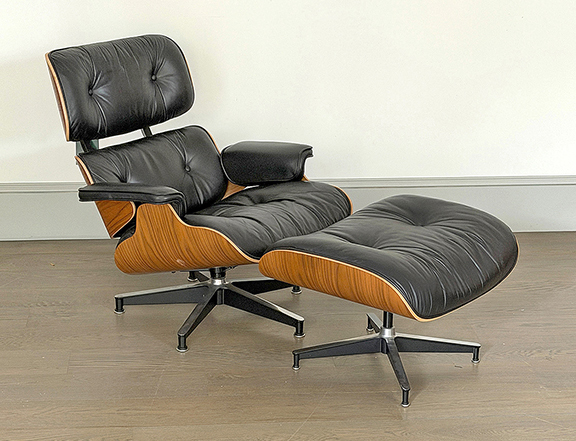
By Charles and Ray Eames for Herman Miller, the walnut lounge chair and ottoman upholstered in leather are numbered 670 and 671, respectively. They came from a Back Bay collection and sold for $4800 (est. $2500/3500).
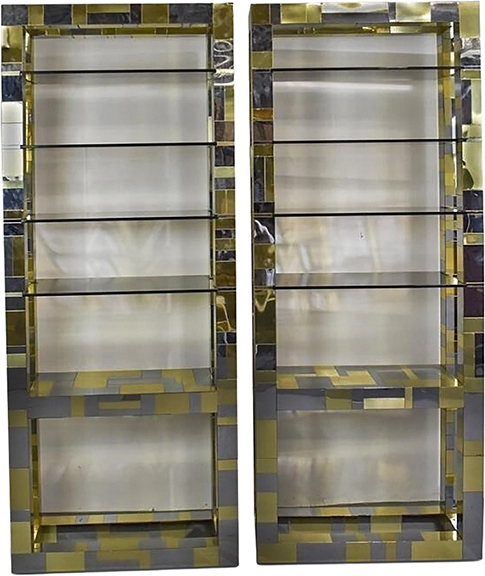
This pair of Paul Evans (1931-1987) “Cityscape” bookshelves of chromed steel, brass, and glass in an abstract geometric pattern inspired by Brutalism was popular and stirred bidding, selling for $3520 (est. $1000/1500). Dated from the 1970s, each is 7'10" high and signed “An Original Paul Evans.”
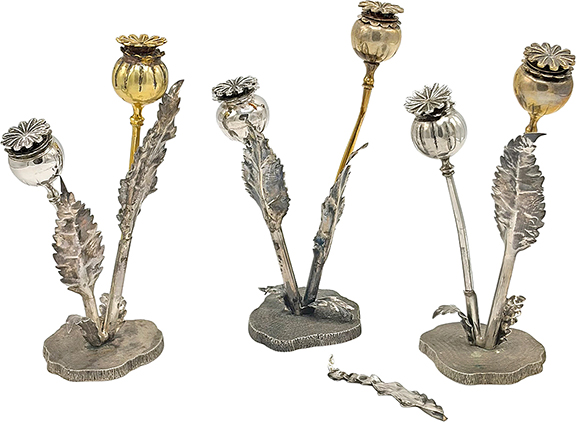
Three pair of late 20th-century Buccellati silver and parcel-gilt “Poppy” salt and pepper shakers were made in Milan and signed “M. Buccellati.” Estimated at $1000/1500, the group sold for $5120.
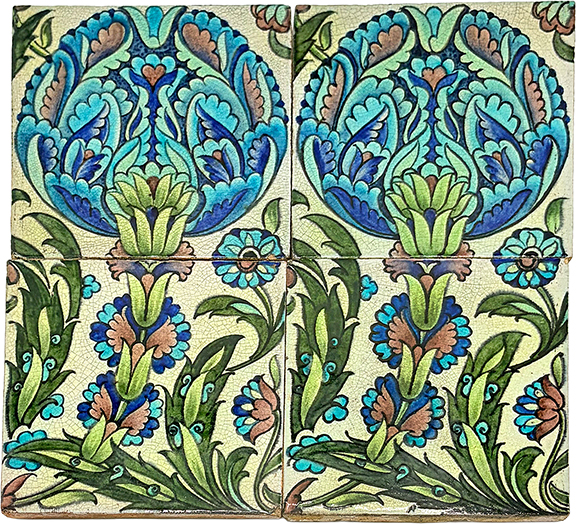
Four tiles in an Islamic design by British artist, ceramicist, designer, and novelist William De Morgan (1839-1917) dated to between 1888 and 1907. Executed in rich colors, two bear a Sands End Pottery mark (De Morgan’s own pottery in Fulham), and two bear an impressed mark, “DM98.” De Morgan was a lifelong friend of William Morris, and the two, leading lights of the Arts and Crafts movement, collaborated frequently. The four tiles measure 6" x 6" and sold for $3840 (est. $800/1200). They came from a Boston collection.
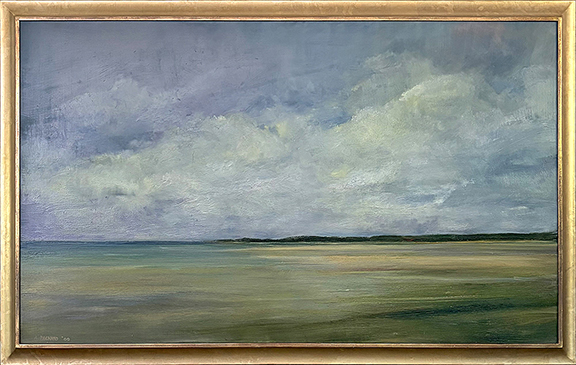
Anne Packard (b. 1933), Seascape, oil on board, 35¾" x 59¾" (sight size), signed and dated “A. Packard ’00,” sold for $19,200 (est. $15,000/25,000). It came from a southern collector who acquired it in 2000 from the Packard Gallery in Provincetown, Massachusetts.
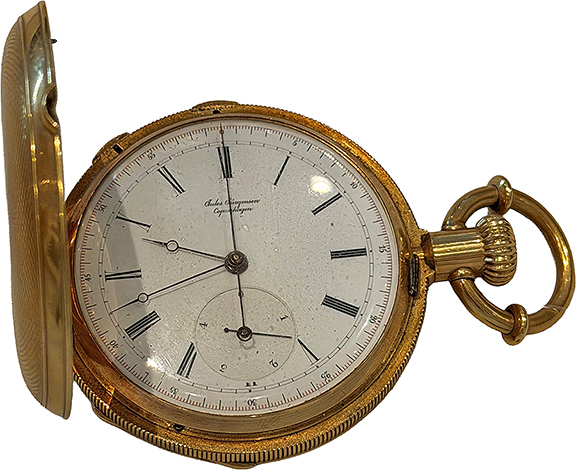
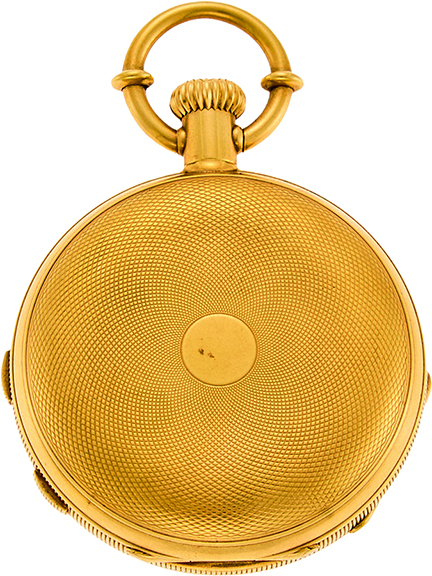
This Jules Jurgensen 18k gold split-second chronograph hunting-case pocket watch with a white porcelain enamel dial, Roman numerals, jump seconds subsidiary dial, and blued-steel Breguet hands sold for $8960 (est. $4000/6000). It is signed “Jules Jorgensen, case no. 11030/2,” and the cuvette is inscribed “James J. Feather / to James J. Feather Byers / April 24 1924 / Wedding Present.” Danish Swiss watchmakers Jules Jurgensen was established in 1740.
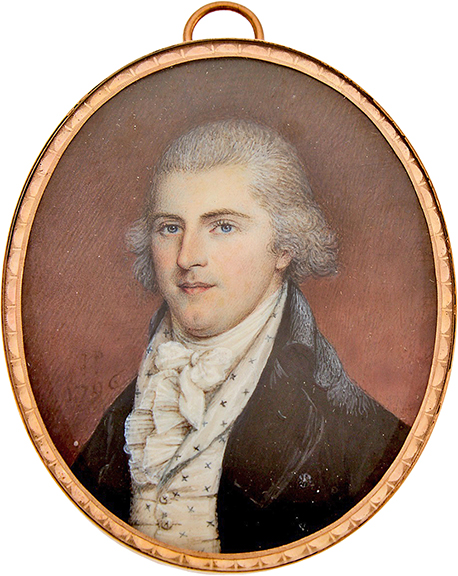
This low-karat rose gold pendant with a painted portrait came from a Maryland collection and realized $5440 (est. $400/600).
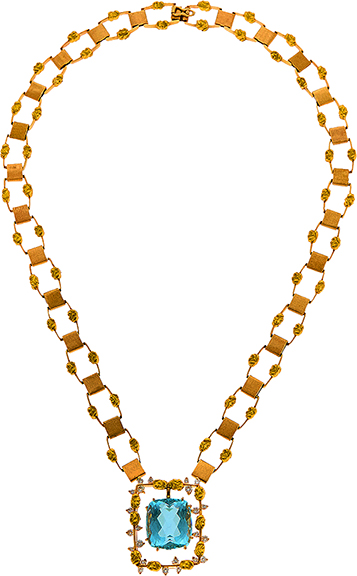
This gold, aquamarine, and diamond pendant necklace from a New England collection sold for $8960 (est. $6000/8000). A centered cushion-shaped aquamarine of approximately 22 carats, surrounded by 23 round diamonds, is set within an intricate gold chain.
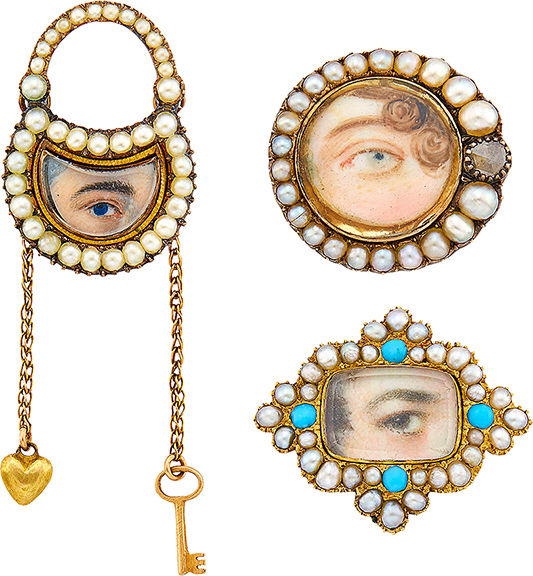
This group of lover’s eyes portrait pins sold for $5760 (est. $1000/1500). All are low-karat gold with small split pearls, one with a turquoise, another with a rose-cut diamond, and the third with a heart and the key to it on hanging gold chains.
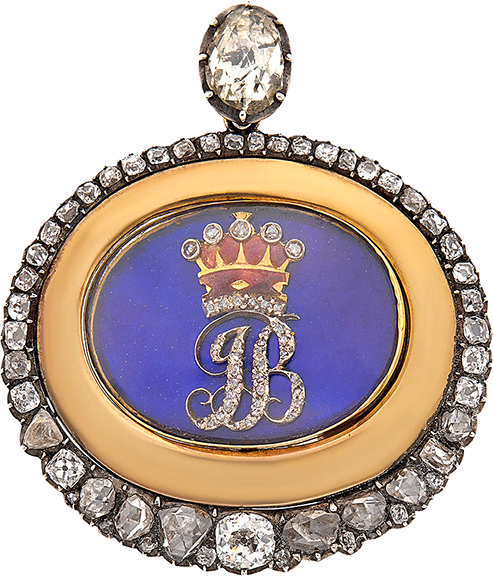
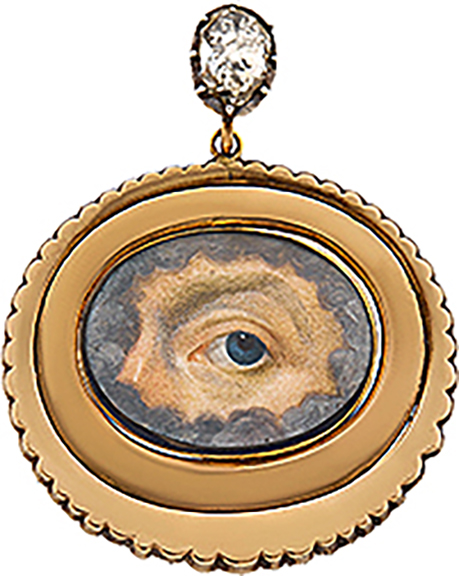
This lover’s eye portrait pendant in low-karat gold, silver, and cobalt glass, has one oval foil-backed rose-cut diamond and one half-carat old-mine-cut diamond and old-mine and rose-cut diamonds, and the “J.B.” monogram, while the reverse holds a painted eye portrait surrounded with painted clouds. Dated to around 1820 and estimated at $2000/3000, it sold for $5760. It was purportedly the eye of Joseph Bonaparte (Napoleon’s brother). The eye swivels to display the gem-set royal crown and the initials.
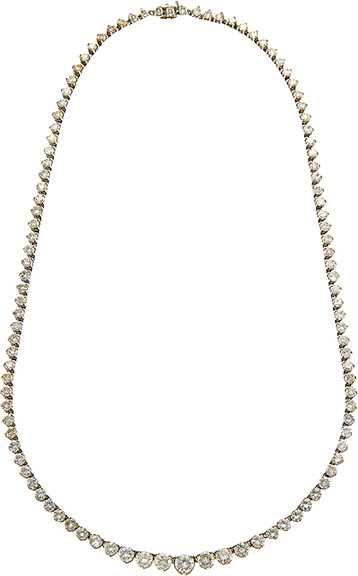
This 14k white gold and diamond necklace of 107 round diamonds, approximately 18.70 carats, 13.5 dwts., came from a New England collection. Measuring 18½" long and estimated at $8000/12,000, it sold for $10,240.
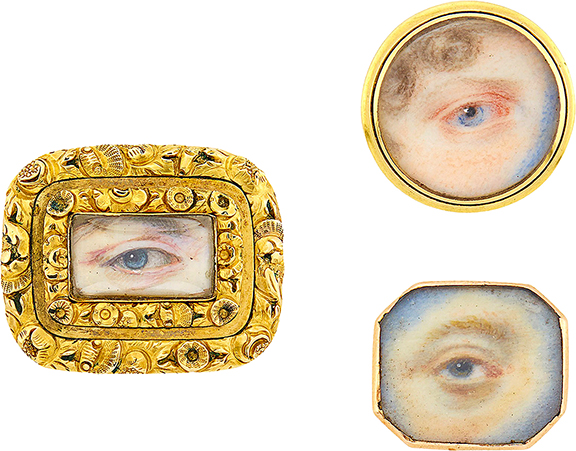
Three gold lover’s eye portrait pins date between 1817 and 1831. Two of the three bear personal engravings on the reverse. They sold for $5760 (est. $500/700). Because lover’s eyes were usually secret gifts, little is known about the senders or recipients.

Originally published in the December 2026 issue of Maine Antique Digest. © 2026 Maine Antique Digest