

















Heritage Auctions, Dallas, Texas
Photos courtesy Heritage Auctions
In celebration of the 250th anniversary of the signing of the Declaration of Independence, Heritage Auctions, Dallas, Texas, held a week-long series of auctions devoted to American and political history, including flags, documents, currency, and other treasures.
The event included three auctions of single-owner collections and was capped off by the headlining event: “Liberty & Legacy: 250 Years of the American Spirit Americana & Political Signature Auction” on June 25. Among the highlights of this event were iconic relics, presidential artifacts, wartime archives, and documents relating to extraordinary moments connected to the nation’s founding and defining moments of its development over the years. Auction items came from multiple owners.
“Each of these auctions explored a different chapter in the American story, but together they formed a remarkable narrative stretching from the Revolution to the modern presidency,” stated Joe Maddalena, executive vice president of Heritage Auctions. “Collectors clearly recognized the opportunity to become stewards of objects that witnessed, and in many cases, helped shape the defining moments of American history.”
Combined sales from the four auctions reached $8.5 million, one of the most comprehensive events of Americana and political material for the Dallas-based auction house.
“These four auctions demonstrated the remarkable breadth of American history that survives in private hands,” said Caroline Tamposi, Americana & Political consignment director for Heritage Auctions. “From the Revolutionary War through Lincoln’s presidency and into the 20th century, collectors responded to objects that preserve the people, events, and ideals that continue to define the American experience. It was a fitting way to commemorate the nation’s approaching 250th anniversary.”
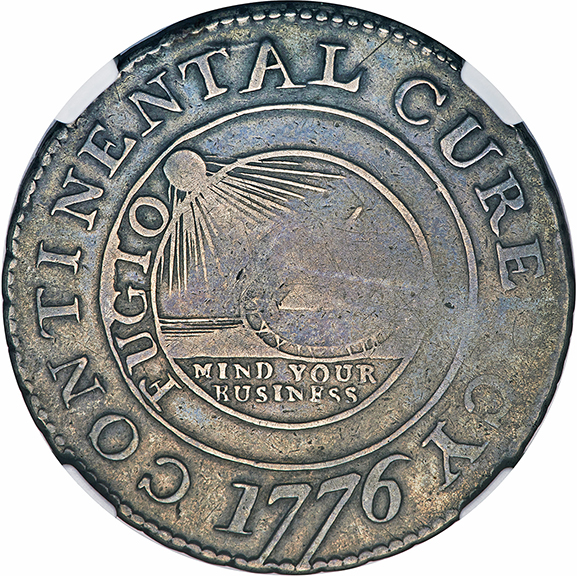
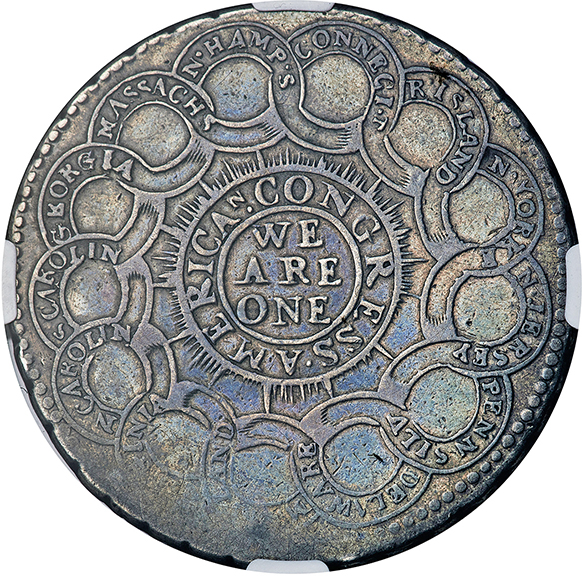
This 1776 Continental $1 coin struck in silver, sold for $1,312,500. The coin, shown obverse and reverse, is believed to have been designed by Benjamin Franklin and is one of only four known silver examples, which include the motto “Mind Your Business” alongside interlocking rings symbolizing the original 13 Colonies. The coin is 373.3 grains. The four Continental currency coins were struck from two die combinations attributed as Newman 1-C and 3-D. Each of the silver coins was struck over a Spanish 8 reales coin from the Mexico City mint. It was sold in the Liberty & Legacy auction on June 25.
“Liberty & Legacy” was the highest grossing of the four auctions, realizing $3,616,250 from 405 bidders. The auction featured 93 lots of which 82 lots sold.
This auction included the highest-selling item of the entire event: a 1776 Continental $1 struck in silver, which sold for $1,312,500 (includes buyer’s premium). The coin was believed to have been designed by Benjamin Franklin. The coin is one of only four known silver examples and bears the motto “Mind Your Business” alongside interlocking rings symbolizing the original 13 Colonies. Also from this auction was a rare Libertas Americana medal commissioned by Franklin to celebrate American independence sold for $475,000.
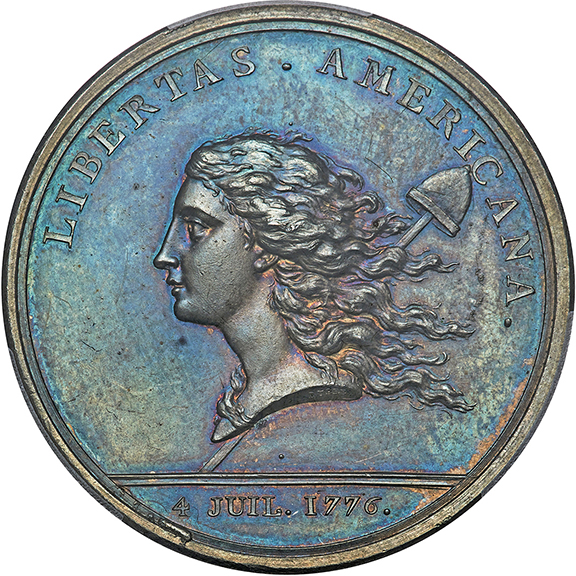
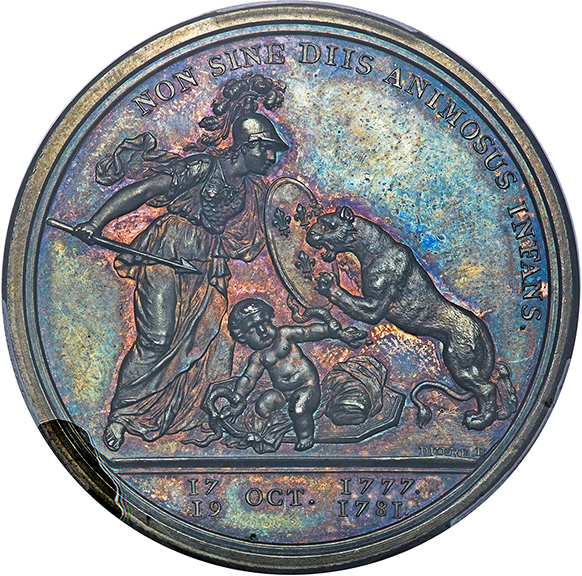
A circa 1783 silver Medal Libertas Americana Medal, shown obverse and reverse, sold for $475,000. The Libertas Americana could be the most important American medal. Examples were struck in bronze, silver, and gold. The silver example was selected to illustrate the front cover of 100 Greatest American Medals and Tokens, where this medal holds the top spot. The obverse side depicts a female head facing left, representing Liberty, her hair flowing back, with a pole and cap over her right shoulder. Above her head are the words “LIBERTAS AMERICANA.” The date, “4 JUIL. 1776” is below. The engraver’s signature, “DUPRE,” is placed on the edge of the bust. The medal sold in the Liberty & Legacy auction on June 25.
The series of auctions began with “The John H. Freund Americana Collection Signature Auction,” which was the second-highest grossing among the four auctions earning $3,209,594 from 189 lots sold. This auction drew 360 bidders. Freund (1932-2025) was a longtime collector of American historical materials, including letters and manuscripts of presidents, military leaders, and other important figures in American history. A letter signed by George Washington describing the successful seizure of Dorchester Heights in March 1776, the military maneuver that forced the British evacuation of Boston and a significant event for the Continental Army, sold for $275,000. A rare issue of The Freeman’s Journal revealing Lord Cornwallis’ surrender at Yorktown, which described one of the earliest printed accounts that helped secure American independence, sold for $125,000.
The June 22 auction of the “Elwood Taylor Collection of American Flags Americana & Political Showcase Auction” realized $390,423. The collection featured flags from the earliest years of American history through the Centennial era. The top-selling item was a 33-Star “Michigan” Great Star American flag from the Wigwam Convention of 1860. It sold for $100,000.
“The Donald Ackerman Collection of Lincolniana Americana & Political Signature Auction” spanned June 23 and 24 and produced sales of $1,284,250. This was the largest of the auctions, with 410 lots and 398 selling. The auction drew 464 bidders.
The Ackerman auction featured a wide range of political campaign items, including flags, banners, ribbons, and other artifacts. The top-selling item from this auction was an 1860 Abraham Lincoln “Wide Awakes” parade banner from western New York, which sold for $106,250. The Wide Awakes was a youth movement that supported Lincoln’s first presidential campaign and was one of the significant political organizations of the era.
For more information, contact Heritage Auctions at (877) 437-4824 or check the website (www.HA.com).
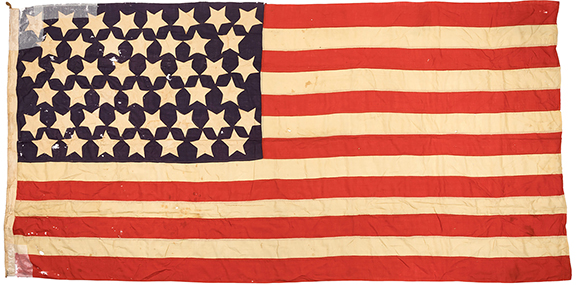
A flag signed by President Theodore Roosevelt to his expedition leader, Nairobi hotelier Major C.H. Ringer, during Roosevelt’s famed 1909-10 African safari, sold for $212,500 (starting bid: $50,000). The 45-star American flag is approximately 68" x 138". The expedition was documented in photographs and early motion picture footage, showing the flag flying over Roosevelt’s wilderness camps, with numerous newspaper accounts also noting its presence during the expedition. Roosevelt’s African journey after completing his presidency was the fulfillment of a long-anticipated adventure. The flag sold in the Liberty & Legacy auction on June 25.
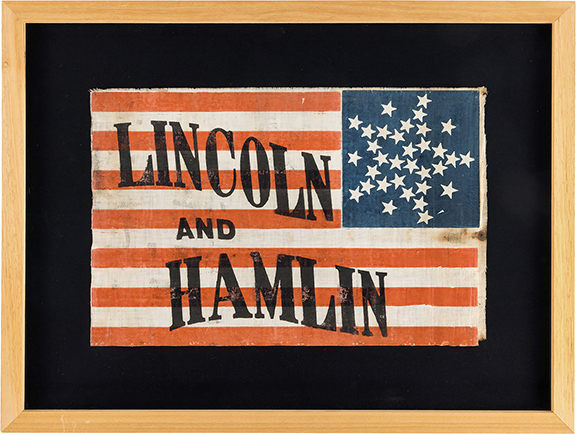
This Abraham Lincoln and Hannibal Hamlin 1860 campaign flag sold for $57,500 (starting bid: $20,000). The 11" x 17" glazed cotton campaign flag is framed to an overall size of 18¼" x 24". It is inscribed “Lincoln and Hamlin” in curved lettering. The canton features a bold five-pointed “Great Star” configuration, with 33 stars forming a larger star, reflecting the pre-Civil War Union. The flag sold in the Donald Ackerman auction on June 23.
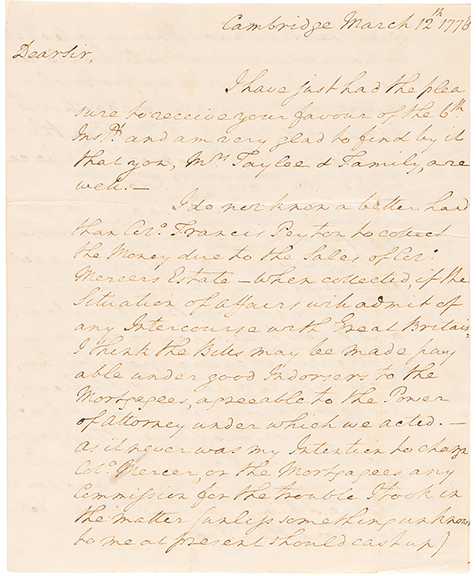
In a letter written in March 1776, a few months before the signing of the Declaration of Independence, George Washington describes the seizure of Dorchester Heights, which forced the British evacuation of Boston. The autographed letter was written by Washington during the siege of Boston and sold for $275,000 (starting bid: $30,000). The letter is written on four pages of a bifolium, 7½" x 9⅛" and is signed: “Go: Washington.” The letter was written in Cambridge, Massachusetts, on March 12, 1776. It was sold in a custom cloth tri-fold presentation case. The letter was written to John Tayloe of Virginia, a prominent planter and political figure. Washington describes the bombardment and British preparations to abandon Boston. The letter sold in “The John H. Freund Americana Collection Signature Auction” on June 19.
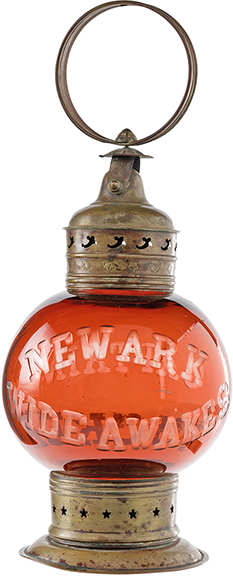
An 1860 Newark Wide Awakes presentation glass lantern sold for $100,000 (starting bid: $30,000). The brass and ruby glass globe lantern, 17" tall x 7" diameter, was presented during the 1860 Lincoln campaign to Captain Isaac M. Tucker of the Newark Wide Awakes. The lantern is inscribed: “Newark Wide Awakes” with the reverse inscribed: “Captain Tucker,” applied in white paint. The base bears the presentation inscription: “Presented to Isaac M. Tucker by the officers of the Hartford ‘Wide Awakes.’” This lantern was awarded during a major 1860 Hartford gathering of Wide Awakes companies, where uniforms and lanterns were ceremonially presented to visiting officers. Tucker, a member of the Newark Common Council and captain of the Newark Wide Awakes, later served as Lt. Colonel of the 2nd New Jersey Infantry. He was mortally wounded at the Battle of Gaines Mill in 1862, reportedly declaring: “It is rather hot in here and some of us will never come out, but the Jersey boys will do their duty. Don’t mind me, but go ahead and give it to them.” The lantern sold in the Donald Ackerman collection auction on June 23.
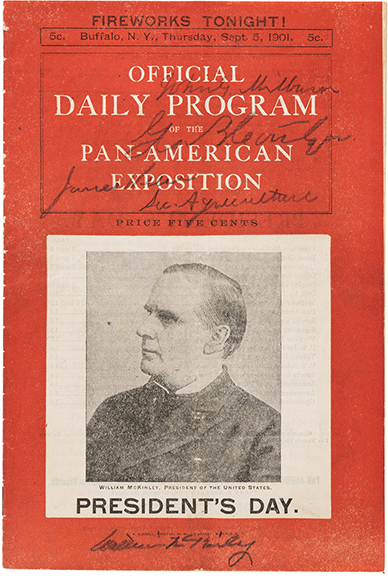
This 8¾" x 5⅞" photograph program signed by President William McKinley the day before he was assassinated sold for $62,500 (starting bid: $5000). On the morning of September 5, 1901, McKinley entered the grounds of the Pan-American Exposition in Buffalo, New York, where more than 50,000 people had gathered. He delivered an address on trade policy and then attended several events. En route to a luncheon, he greeted former New York Congressman Daniel Lockwood and signed Lockwood’s program, which would be one of the last of McKinley’s signatures. The following day, McKinley spent time at Niagara Falls before returning to Buffalo in the afternoon for a public reception in the Temple of Music. It was there that he was fatally shot by Leon Czolgosz, sustaining a wound that would kill McKinley eight days later. The front wrapper displays a black-and-white photograph of McKinley, signed by him in pencil. The program is also signed by Exposition President John G. Milburn; George B. Cortelyou, McKinley’s aide; and Secretary of Agriculture James Wilson. Lockwood’s signature is present on the rear wrapper of the program. The program sold in the John H. Freund auction on June 19.
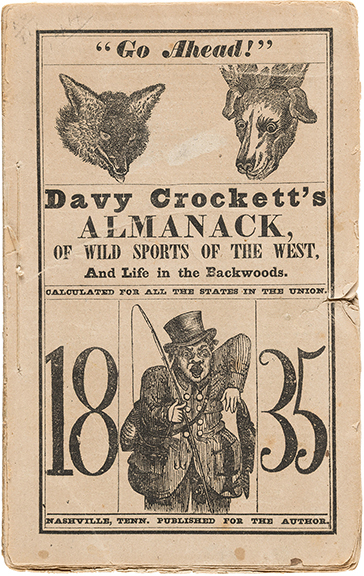
The original Davy Crockett Almanacs, a collection of early American humor, sold for $50,000 (starting bid: $40,000). The collection of Davy Crockett’s Almanack of Wild Sports in the West, and Life in the Backwoods includes original volumes, beginning in 1835, and a complete run through 1856. The collection includes 29 volumes, containing 28 almanacs and one “Dime” bibliography. Wood-engraved text illustrations are displayed throughout. The provenance cites Edward Sands Litchfield, Sotheby’s New York City, November 29, 2001, lot 35, for 22 of the present 29 items; Christie’s New York City, April 25, 2022, lot 152; and the Steven Lomazow, M.D., collection of American periodicals. The almanac sold in the Liberty & Legacy auction on June 23.
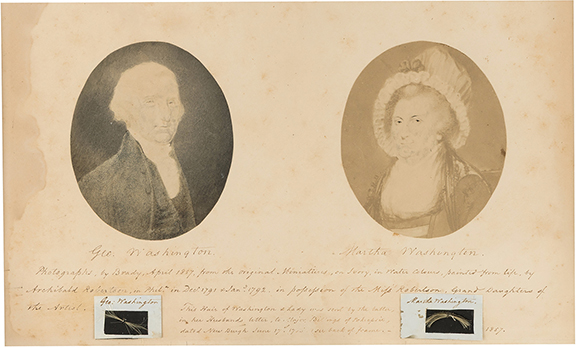
A framed display of photos and hair locks from George and Martha Washington sold for $30,000 (starting bid $10,000). The display, circa 1857, features photos of the Washingtons above handwritten explanatory text. Beneath the text are the respective locks of hair from the President and First Lady. The display included corroborating information from the Smithsonian Institution. The 8" x 13" display is housed in a modern custom frame of 12¼" x 17½". The portraits correspond to miniature watercolor images on ivory of the Washingtons created by Archibald Robertson in Philadelphia in December 1791 and January 1792. The pair of photos and locks of hair sold in the Liberty & Legacy auction on June 25.
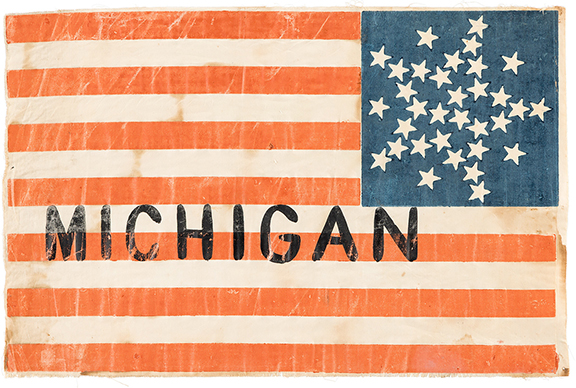
A 33-Star “Michigan” Great Star American flag from the 1860 Republican National Convention in Chicago, referred to as the “Wigwam Convention,” sold for $100,000. The convention was held in a structure built for the event known as the Wigwam. At this convention, Abraham Lincoln secured the Republican presidential nomination along with his running mate Hannibal Hamlin. The 11⅛" x 17" flag is printed on glazed cotton. The flag is from “The Elwood Taylor Collection of American Flags: Americana & Political Showcase Auction” on June 22.
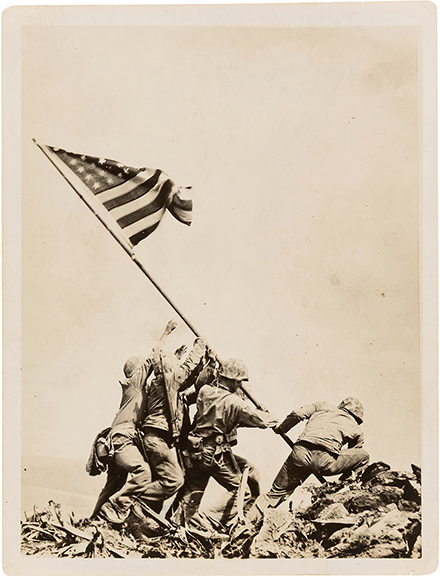
A set of 50 vintage Associated Press photographs of Iwo Jima, anchored by Associated Press combat photographer Joe Rosenthal’s iconic Pulitzer Prize-winning Raising the Flag on Mount Suribachi, Iwo Jima, sold for $21,250 (starting bid: $10,000). Rosenthal shot the photo on February 23, 1945, and it quickly appeared in thousands of publications. The photo won the Pulitzer Prize for photography in 1945. The set of 4½" x 3½" photographs are from the collection of Edward L. Phelps, private First Class 4th/5th Marine Divisions. Phelps was Rosenthal’s close friend and was charged with defending the photographer’s position from fire during the second raising of the flag on Mount Suribachi during the Battle of Iwo Jima in the Pacific. The two stood “back-to-back” while the photo was shot. Rosenthal printed the photos for Phelps while aboard the command ship Eldorado from February 19 to March 9, 1945, which was located off Iwo Jima. The set of photos was identical to those Rosenthal printed for himself. The photos sold in the Liberty & Legacy auction on June 25.
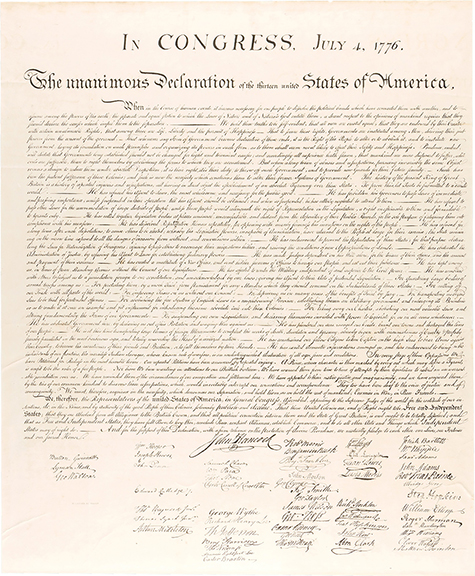
A broadside of the Peter Force’s 1833 printing of the Declaration of Independence sold for $100,000 (starting bid: $10,000). This printing of the Declaration appeared as an insert in American Archives: A Documentary History of the United States of America, Series V, Volume 1, compiled by Peter Force. Crafted by printer William J. Stone in 1823, the copperplate used to produce this copy was originally commissioned by Secretary of State John Quincy Adams in 1820. This version is 30¼" x 24¾". Over three years, Stone painstakingly traced the plate from the original Declaration of Independence. After completing 200 copies, Stone removed the legend from the top of the copperplate and added the imprint “W.J. STONE SC. WASHN.” In 1833, Congress authorized the publication of another 1500 copies. A history enthusiast and mayor of Washington, D.C., Force arranged for his friend Stone to produce the facsimiles. The printer surpassed the agreed-upon number of copies, invoicing Force on July 21, 1833, for 4000 prints. Nevertheless, it is believed that only a few hundred of Force’s printings still exist, including this example. It sold in the Liberty & Legacy auction on June 25.
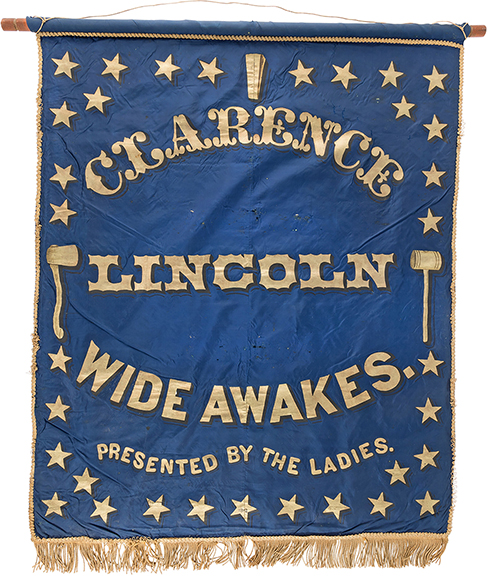
A large 1860 Lincoln “Wide Awakes” blue silk parade banner from western New York sold for $106,250 (starting bid: $40,000). The blue silk banner, 51" x 38", has gilt-painted lettering and adornments. The design is encircled by 33 stars and features Lincoln campaign imagery, including an axe, maul, and wedge, direct references to his “Rail Splitter” persona. The inscription reads: “Clarence Lincoln Wide Awakes. Presented by the Ladies.” The Wide Awakes were among the most influential political organizations of the 1860 campaign, staging highly visible torchlight parades in support of the Republican ticket. The presentation line reflects the important role of women in producing and funding campaign materials even though they were not allowed to vote. The banner sold in “The Donald Ackerman Collection of Lincolniana Americana & Political Signature Auction” on June 23.
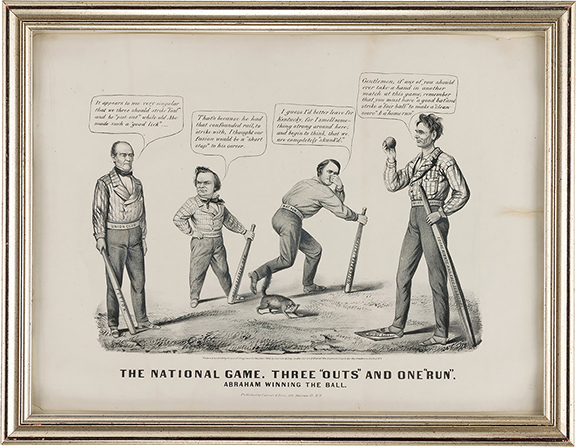
A Currier & Ives baseball-theme political cartoon, 13½" x 18" (sight size), of Abraham Lincoln’s 1860 presidential campaign sold for $47,500 (starting bid: $7500). The cartoon is titled: “The National Game. Three ‘Outs’ and One ‘Run.’” The subtitle states: “Abraham Winning the Ball.” Each of the four presidential candidates are portrayed wearing a belt with the name of his respective team (or political party) and each carrying a bat indicating their political program or platform. Lincoln seems to be on the verge of winning the contest as he stands on home base and dispenses advice to his losing opponents on how to succeed in this game. The cartoon sold in the Donald Ackerman collection auction on June 23.
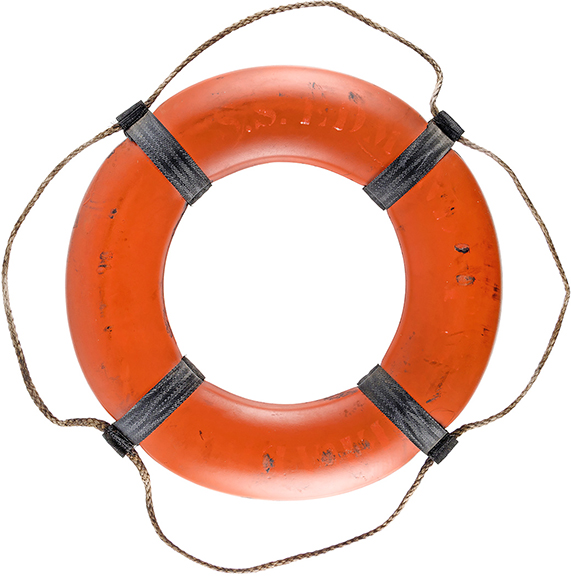
A life preserver from the wreck of the SS Edmund Fitzgerald sold for $20,000 (starting bid: $5000). The Edmund Fitzgerald was the largest ship traversing the Great Lakes at the time of its launch in 1958. The ship was capable of carrying enormous loads of iron ore across the lakes to steel mills. On the morning of November 9, 1975, the ship left Superior, Wisconsin, with its holds filled with taconite pellets bound for Zug Island near Detroit. But Lake Superior, known for unpredictable and violent weather, unleashed hurricane force winds of nearly 100 miles per hour in what was recorded as one of the most ferocious storms on the Great Lakes. That evening the ship broke apart and plunged into more than 500 feet of icy water near Whitefish Bay in Canada. All 29 crew members aboard were lost. Search crews recovered scattered remnants, including life jackets, inflatable life rafts, and a lifeboat. The recovered Edmund Fitzgerald life preserver is approximately 28¾" inches in diameter and 3½" inches in depth. The orange ring buoy has four black reinforcing bands securing a nylon rope. Faint stenciled lettering reads “S.S. EDMUND FITZGERALD.” Manufactured by B.F. Goodrich, with raised marks and stamped: “ATLANTIC-PACIFIC MFG CORP / BROOKLYN NEW YORK / #840.” Similar life preservers from the Edmund Fitzgerald are on display in museums in the Great Lakes area. The preserver sold in the Liberty & Legacy auction on June 25.

Originally published in the October 2026 issue of Maine Antique Digest. © 2026 Maine Antique Digest