





















Beneath the Surface
Hollie and I lost our mothers many years ago, and while it is true that you only have one mother, if you are lucky, you get someone who loves you enough to make the effort to fill that gap anyway. We have both been just that fortunate, and our fathers have found companions with whom to share their lives who have enthusiastically become friends, caretakers, planners, dispensers of wisdom, grandmothers, and more: in short, family. If a child is having a birthday, Granny or Bunny shows up to offer helping hands. Granny and Bunny always have Band-Aids, cortisone cream, nail clippers, acetaminophen, and an ink pen. When one of our fathers has a cold, we do not have to worry, because Granny or Bunny will go to the pharmacy, make a hot meal, and insist on the doctor. They are there when we cannot be, and they sweeten our lives immeasurably, so much so that regularly we say to each other or our siblings, “God bless Bunny” or “God bless Granny.”
It does not take that much to make a life—the ability not to freeze and not to starve are pretty basic—but to make a life that is rich, warm, rewarding? That is all the small stuff. The “right kind” of milk for your morning coffee, a new pillow when the old one is getting flat, a good British mystery show that is new to PBS—those are the things that make life comfy and enjoyable. We heap blessings on all the people in our lives who care enough to notice and tend to the small stuff.
And because of this, in the course of our work, we also often find ourselves saying, “God bless the nerds.” A good history nerd somewhere out there, not even in the present day, but decades ago, can save a person hours of research! Our reference library is filled with volumes from people who cataloged the most ordinary of objects, things like union cases and silver marks, or transcribed daybooks and probate inventories. It is easy to forget that, just like any lab scientist, researchers in the antiques world also stand on the shoulders of giants!
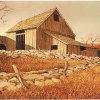
Take, for example, our recent auction production cycle. We had a lovely little New Hampshire landscape. It was nothing on the order of Edmund Darch Lewis or Maxfield Parrish but a pleasant little scene from the Antrim area, neatly signed “Eugene H. Jones” and dated “1942.” To Hollie, these details did not seem especially promising. (One of the requisite skills of a researcher is having a sense of when something is a dead end…and yet also not being willing to accept dead ends. Hollie paraphrases E.B. White: “I arise in the morning torn between the belief that I can track down anything and the belief that such detailed research seems impossible. This makes it hard to plan the day.” Also, Andrew has what Hollie feels is an overinflated opinion of her abilities— “I do not!” he exclaims from the other room—making him exceedingly optimistic sometimes.)
Why the pessimism? From a research standpoint, Eugene H. Jones is a pretty ordinary name, and the painting is one of a fairly routine scene. The painter might be someone who isn’t even remotely local, because people traveled from all over to do their en plein air sketches of New England. In short, there are likely to be a lot of possibilities, but few ways to narrow them down; however, there is a Eugene Jones about 30 miles away in the Goffstown area.
That Eugene Jones, after a bit of poking, seems to have been born in Cambridge, Massachusetts, and he lived most of his life in the greater Boston area, maintaining streetlights for the Edison Electric Company. He only moved to New Hampshire later in life as a retiree. So now, even after identifying a Eugene H. Jones in the area, and this painting is clearly the work of an amateur, how would a person begin to prove that some random Eugene H. Jones had a little landscape painting hobby on the side? Unless there are stacks and stacks of canvases out there (there did not appear to be), and if they did not have much in the way of monetary value, then any resulting artwork might not be sold in ways that result in photographic documentation and records.
Frustrating, yes, but this would be like someone trying to prove 70 years from now that we were knitters or readers or avid gardeners or spatterware collectors. If it does not make it into the obituary, for so many people there is very little record left of a personal nature. On the one hand, historically, obituaries used to be in one place—the local newspaper. On the other, that meant they were often quite brief, unless someone was a prominent local citizen, frequently only listing immediate surviving families. (We cannot tell you how many widowed older people never even seemed to get any sort of death notice, with no one left to make sure one was placed.) So, still we are left with the question of how we ever prove that Eugene is this Eugene.
Enter, triumphantly with fanfare, the November 1937 newsletter of the American Association of Variable Star Observers (AAVSO), lovingly scanned in, we like to think, by some like-minded nerd out there! Turns out that Eugene H. Jones, streetlight maintenance man, was also a devoted amateur astronomer! Variable stars are stars whose brightness varies across time, sometimes in a linear way, as the star’s lifecycle winds down, but also because other orbiting objects pass between us and them. This means they have great importance to astronomers because the variations in brightness can help determine distances between celestial bodies and because their dimming can hint at the presence of previously unknown bodies.
Eugene was an extraordinary observer, making more than 35,000 recorded observations in his lifetime, and he retired to Goffstown for precisely that reason—superior stargazing conditions, especially when compared with Boston! (A great irony, Hollie thought, that he maintained the lights that kept him from seeing the lights he most wanted to see.) And because Eugene was so highly regarded and well-respected, he received an award of merit from the AAVSO, and they did a lovely write-up about his life, his contributions, and his interests—including his other hobby of landscape painting.
And all that is possible because someone somewhere felt passionately enough about the American Association of Variable Star Observers to digitize their newsletters and make them available in some measure, and of course the tidbit only appeared there to begin with because Eugene H. Jones of Goffstown, New Hampshire, felt passionately enough about variable stars to commit himself to observing them.
And when one stops to think how much of our research work is built upon grassroots, crowd-sourced foundations of data, it is astounding! From Wikipedia to Find A Grave to the local historical archives, much of that work has been lovingly compiled by people who never made a dime for their efforts. Citizen historians—they are just out there doing it because they love it, because they think it matters, because they found something worthwhile and think someone else should be able to find it too. Bless the nerds who wander around in cemeteries making transcriptions of gravestones, who spend dusty hours in county courthouses, who type up lengthy blog entries on the scattered pieces of whatever puzzles they are working on, and who share it all so freely.
Does this make the painting more valuable? Probably not. Maybe a little? But the point is that we manage to connect another little piece to Jonesey, as his astronomy friends called him, and perhaps this connection between artist and artwork will not be entirely lost now. It is startling how quickly people get reduced to date of birth and death, spouses, children, place of residence. All of the details that make the people we love and us who we are, those get lost pretty quickly. Who made the best lemon meringue pie, spent decades volunteering with the fire department, wiggled their ears to make babies laugh, could nurse a weak calf back to life—it goes so fast, the very best of who we are. The nerds among us keep track of who we are, who we have been, and the things that are small but not at all insignificant.
Of course, it is not just nerds. We bless anyone with a heart that beats for the small things, the unnoticed things, the things that they do because those things should be done by someone and no one else seems to be around.
Whether they take home that one sickly kitten or stop for 30 minutes to clear a storm-fallen tree in the road or wave at a child in a bus window—or digitize documents from the past, they are honoring who we are and what makes us human, what makes a life a Life, what makes the world a warmer, brighter, richer place.
We do stand on the shoulders of giants. Or giant nerds. And we aspire to be the nerds on whom future nerds stand! We like to think that our research, whether shared in auction catalogs, exhibitions, lectures, or even just Facebook posts, will someday be found by someone else, who will smile and say to themselves, “God bless nerds.”

Originally published in the November 2026 issue of Maine Antique Digest. © 2026 Maine Antique Digest