
























Guyette & Deeter, Easton, Maryland
Photos courtesy Guyette & Deeter
The July 24 and July 25 Guyette & Deeter sale included part two of the Jim and Diane Cook collection of 63 lots, all of which sold. The combined gross of those lots was $3.67 million (including buyers’ premiums). Part one of the Cook collection of 132 lots, which also all sold, crossed the block in April and grossed well over $7,000,000, with two decoys selling for over $1,000,000 each. So far, the Cook collection has earned well over $10,000,000, and more will be sold in the next two auctions.
This sale also included a strong selection of Illinois River carvings, along with groupings of works by the Ward brothers and other Chesapeake Bay carvers, Del-Marva peninsula carvings, decorative carvings and miniatures, as well as birds from Canada, New York, and other regions. There were more than 20 works by A. Elmer Crowell (1862-1952). There were 50 lots of fish decoys, 30 lots made by the Mason Decoy Factory, folk art including a cigar-store figure and walking sticks, sporting paintings, and more.
The live sale in Easton, Maryland, drew a large active crowd that bought many of the offerings. The 574-lot sale grossed $6,495,750. About 25 lots were passed. More than a dozen carvings earned over $100,000, many of them from the Cook collection. Leading the sale, perhaps not surprisingly, was Crowell’s wood duck, with a slightly turned head and relief-carved tail feathers; it realized $570,000 (est. $120,000/180,000). The decoy is well known to the collecting community, having been pictured in two books. Four pages of this 370-page auction catalog, which includes dozens of essays with little known facts and original research by Bill LaPointe, are also devoted to this decoy.
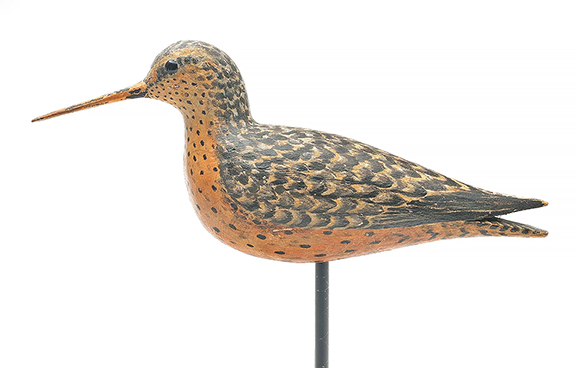
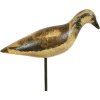
Elmer Crowell’s shorebirds are especially popular with collectors. According to the catalog, this 11¼" long dowitcher in summer plumage is the only example known, and it brought $192,000 (est. $30,000/50,000).
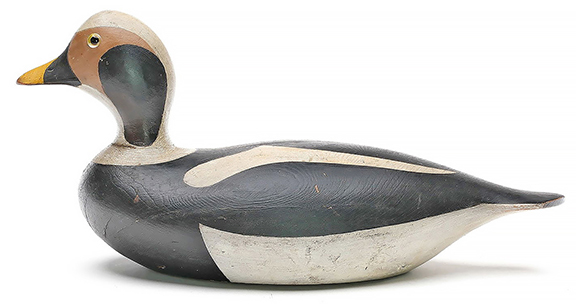
The second-highest price of the sale, $330,000 (est. $120,000/180,000) was earned by a rare 15" long Joe Lincoln (1859-1938) long-tail duck in original paint. It was a rigmate of one of the birds that sold for over $1,000,000 in the April sale. A miniature carved Canada goose by Lincoln (not shown) sold for $2700 (est. $1500/2500).
Of the 20 Crowell offerings, five sold for more than $100,000—many to the same phone bidder. His carvings included shorebirds and decorative carvings. One shorebird with split-tail carving was a dowitcher in summer plumage. It is the only one known, according to the catalog, and it brought $192,000 (est. $30,000/50,000). Of his decoratives, one was a drop-winged woodcock, with relief-carved wings and tail. Its base has holes, as if the bird had drilled them while seeking food. It realized $156,000 (est. $30,000/50,000). The second-highest price of the day, $330,000 (est. $120,000/180,000) was earned by a Joe Lincoln (1859-1938) carving of a rare long-tail duck in original paint and a rigmate of one of the birds that sold for over $1,000,000 in the April sale. A miniature Canada goose by Lincoln, only 6½" long, earned $2700 (est. $1500/2500).
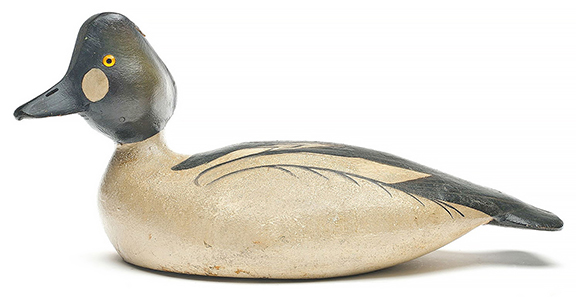
Lemuel Ward (1896-1984) gifted this goldeneye to Dr. Edgar Burke, his good friend and customer. With a turned head and measuring 15" long, it was one of the gems of the Cook collection, selling for $156,000 (est. $80,000/120,000).
The Ward brothers of Crisfield, Maryland, in the Chesapeake Bay area, produced exceptional carvings, and their goldeneye was one of the gems of the Cook collection. Its head is turned at a 45-degree angle, and is marked “To / Dr. Edgar Burke / With The / Makers Complements / L.T. Ward Jr.” Among the several informative essays in the catalog was a full-page one devoted to Burke, which refers to him as “one of the most widely known, accomplished, well-rounded, sportsman and artist of his day.” The decoy sold for $156,000 (est. $80,000/120,000).
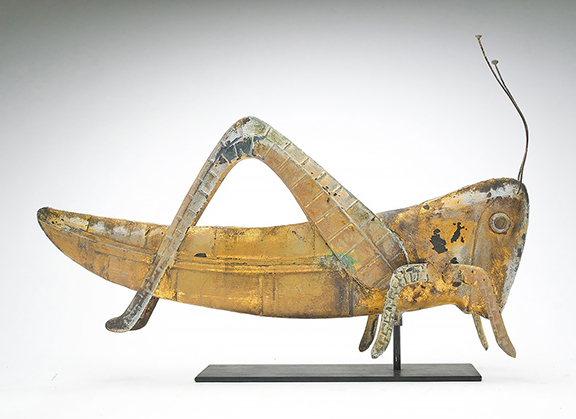
The folk-art selection included this full-body copper weathervane in the form of a grasshopper, which earned $9600 (est. $800/1200). It is 25" long. The legs and antenna were applied separately, and traces of gilding remain.
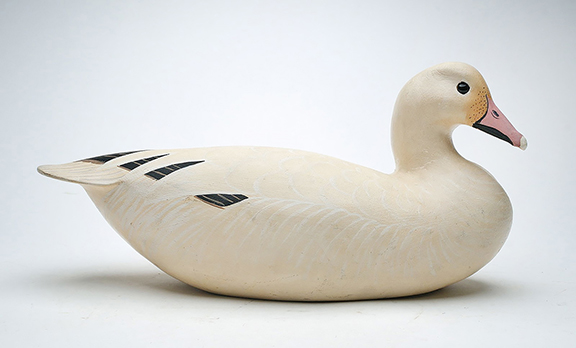
Some of the less common decoys carved by the Ward brothers were snow geese. This one, just under 19" long, is dated “1966” and signed. It sold for $5700 (est. $5000/8000).
One carving from the Ward brothers was an uncommon gull signed and dated “1968.” It sold for $9600 (est. $2500/3500). Another of their less common birds was a snow goose, almost 19" long, which realized $5700 (est. $5000/8000). All were surprised by one of the Crisfield-area decoys, which turned out to be the highest-priced item sold on the second day. Described as a “rare and important early” example, the well-worn goldeneye decoy has little of the original paint remaining. Carved by Noah Sterling (1884-1954), it earned $57,000 (est. $8000/12,000).
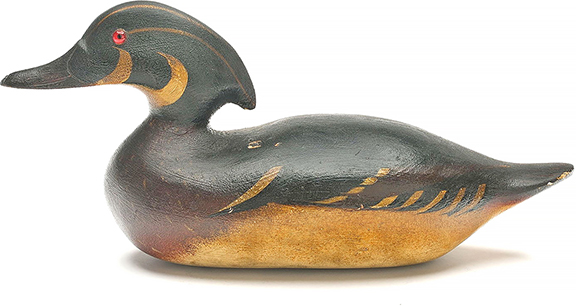
This 12½" long wood duck was made by the Mason Decoy Factory and was one of several Masons in the sale. It had stayed in the Mason family, and it sold for $144,000 (est. $50,000/80,000).
Mason Decoy Factory birds are, along with the works of Crowell, the most collected decoys. There were some in the Cook collection and several from other consignors. Bringing the top price of the category was a Premier-grade wood duck that had descended in the Mason family. Selling for $144,000, it far exceeded the estimate of $50,000/80,000. One of the attractions of Mason decoys is that they can be had at a variety of prices. Three in this sale brought under $1500, and one, a blue-winged teal hen in original paint with some condition issues, sold for $720 (est. $600/900). The Mason factory and its output are well documented in two books by Russ Goldberger and Alan Haid.
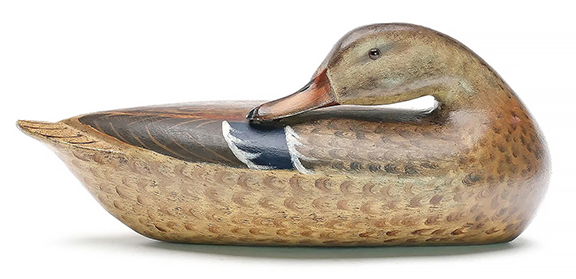
One of the important Illinois River decoys was this 14¾" long preening mallard hen by Charles Perdew (1874-1963). With original paint intact, it realized $168,000 (est. $100,000/140,000). It had been in other well-known collections before being acquired by the Cooks.
The catalog is partially organized by geographic areas: New York, New Jersey, Canada, Michigan, New England, etc. As with other geographic areas, the Illinois River area developed a distinct style of decoy. The sale included several examples and was topped by a Charles Perdew (1874-1963) preening mallard hen, nearly 15" long, which sold for $168,000 (est. $100,000/140,000). Not all good carvings by well-known carvers cost five- and six-figure prices. A good example is Perdew’s decorative carving of a crow, which sold for $1200 (est. $1200/1800). Other works were also included by Illinois River carvers Bert Graves (1880-1956), Otto Garren (1890-1968), Charles Walker (1873-1954), and Robert Elliston (1849-1915). An Elliston mallard sold for $9000 (est. $5000/8000); a Bert Graves mallard hen brought $18,000 (est. $10,000/14,000); and one of the Otto Garren offerings, a pair of wood ducks with exaggerated crests, reached $15,600 (est. $6000/9000). There were many more.
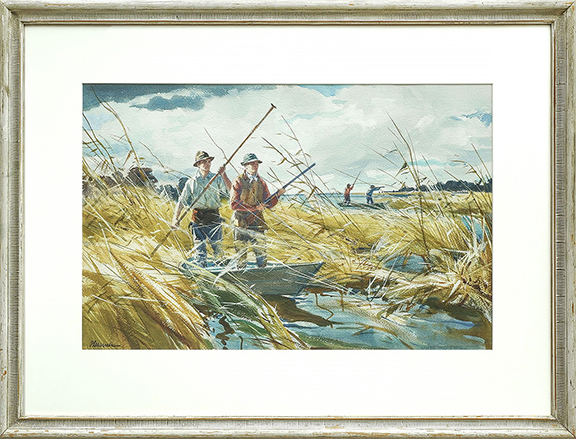
The sale included numerous examples of sporting art. This Ogden Pleissner (1905-1983) watercolor, 16½" x 25½" (sight size), went out for $51,000 (est. $30,000/50,000).
A cigar-store figure attributed to Samuel Robb (1851-1928), a noted New York City carver, led the folk-art offerings. This figure has long, flowing hair and is holding a box in one hand and tobacco leaves and a spear in the other. Some of the paint is not original. Its provenance can be traced to the 1956 Parke-Bernet Galleries auction of the Rudolf Haffenreffer collection, which is still regarded as one of the finest collections ever assembled. Some of the figures from Haffenreffer’s collection are in major museum collections such as the Smithsonian. This figure was consigned from the Mark Goldman collection and sold for $51,000 (est. $30,000/50,000). A serious collector or student of cigar-store figures might enjoy tracking down an original copy of a very illusive book on the subject, Hunting Indians in a Taxi-Cab, written by Kate Sanborn and published in 1911. Sanborn hired a taxi and rode around New York City photographing cigar-store figures in front of tobacco stores.
The collection of carved walking sticks in the sale ranged in price from $240 to $2100. A 60" long model of a rowing scull brought $6300 (est. $2000/3000). The catalog states that rowing is the “oldest intercollegiate sport in America.”
This sale included a comprehensive selection of decoys, offering the work of many carvers. Afterwards, Jon Deeter commented on the strength of the sale: “We had a two-day total of well over six-million dollars, and the rarities in the Jim Cook collection drew very completive bidding. We will probably stretch the rest of those birds out, probably into next year. I think some of our buyers need to ‘recover’ a little. And there are several other strong collections, so the next few sales are looking good. The turnout for the preview was strong, and bidders in the salesroom were competitive.”
For additional information, visit the website (www.guyetteanddeeter.com) or call (410) 745-0485.
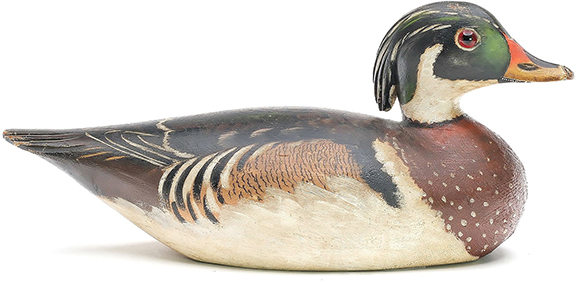
Leading the sale, from the James and Diane Cook collection, was an A. Elmer Crowell (1862-1952) wood duck with original paint and slightly turned head. It is 13½" long and earned $570,000 (est. $120,000/180,000). There were 20 examples of Crowell’s carvings in the auction—decoys, miniatures, and decoratives—and all did well, most finishing over the estimates.
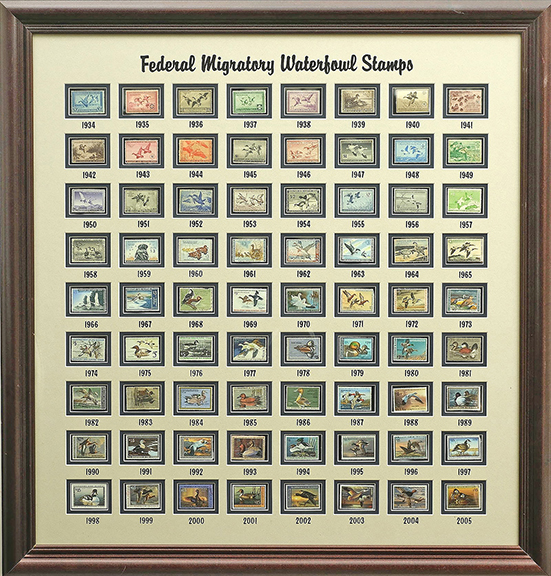
Duck stamps have been issued since 1934 by the Federal government, with most of the money raised going to the protection of wildlife habitat. A set of the stamps, from 1934 to 2025, in two frames (one shown), realized $4500 (est. $1500/2500).
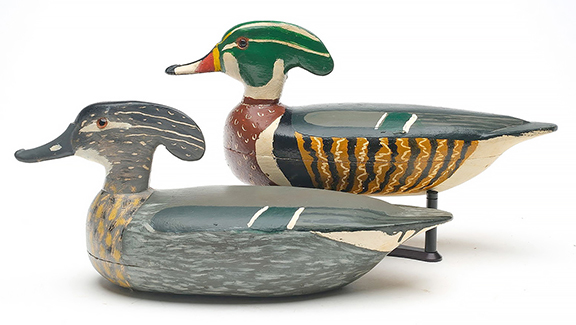
This pair of 12¾" long hollow-carved wood ducks with exaggerated crests by Otto Garren (1890-1968) of Canton, Illinois, earned $15,600 (est. $6000/9000).
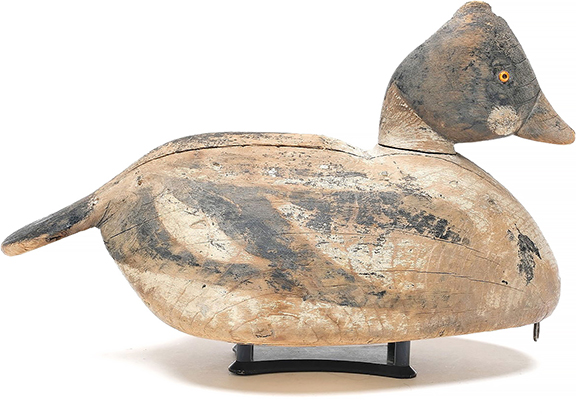
One of the surprises in the auction was this well-worn, 15½" long goldeneye made by Noah Sterling (1884-1954) of Crisfield, Maryland. In addition to most of the paint being missing, it has some other minor condition issues, but two bidders wanted it, and it finished at $57,000 (est. $8000/12,000).
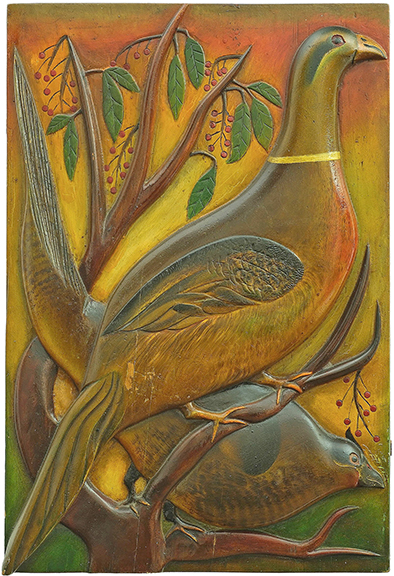
Michigan’s Oscar Peterson (1887-1951) is known for his carvings of fish and other wildlife. This heavily carved 22" x 15" x 1½" plaque of pheasants was sold for $12,000 (est. $15,000/20,000).
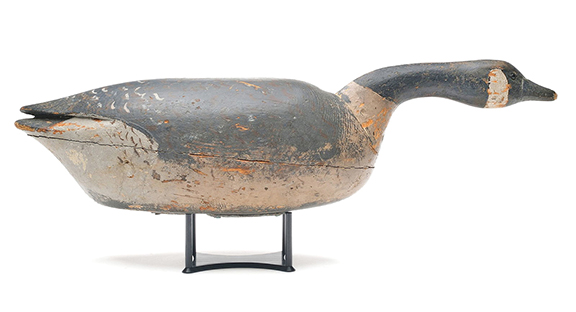
At 29½" long, this goose is certainly a large decoy. It was made by Nathan Cobb Jr. (1825-1905) of Cobb Island, Virginia, from the well-known Cobb family of carvers. The Cobb family purchased the island in the mid-19th century and developed thriving businesses, which included a famed hunting lodge. Decoys carved by family members were used on the island. This goose sold for $120,000 (est. $50,000/80,000).
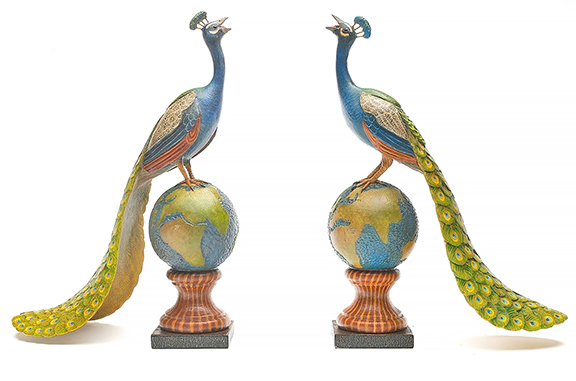
Frank Finney (b. 1947) is a major contemporary folk-art carver. He has a fertile imagination, making a variety of forms, which are rarely duplicated. This pair of peacocks, standing on terrestrial globes, is 13½" tall and sold for $14,400 (est. $8000/12,000).
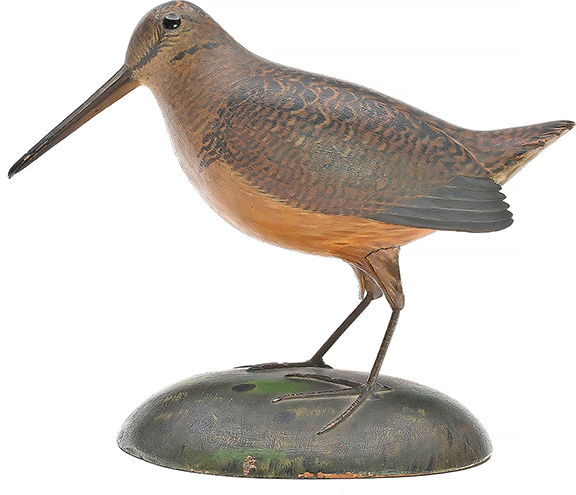
Elmer Crowell’s decorative woodcock, 10½" long, sold for $156,000 (est. $30,000/50,000). It has a drop wing with relief-carved wing and tail. The holes carved in the base as though the bird had been hunting a meal are an interesting detail.
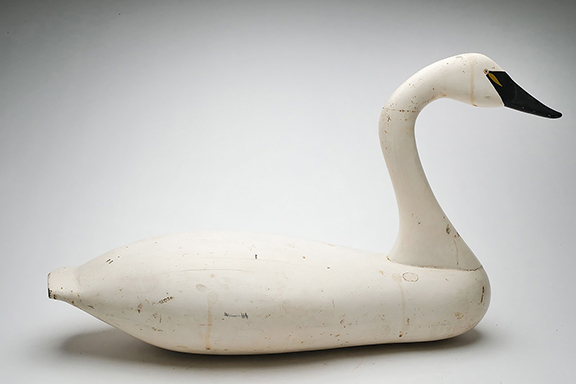
Swan decoys are large and impressive but not all that common. This one, made by Charles Joiner (1921-2015) of Chestertown, Maryland, is 33½" long and realized $10,200 (est. $4000/6000).
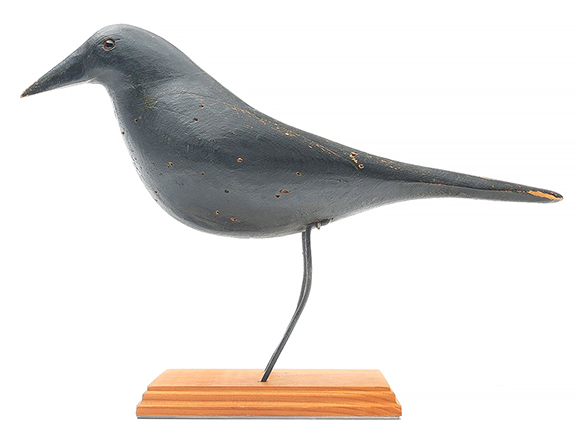
Yes, some of the decoys by Charles Perdew (1874-1963) sold for six-figure prices but not all. This 15½" long crow with a laminated body went out for $1200 (est. $1200/1800).
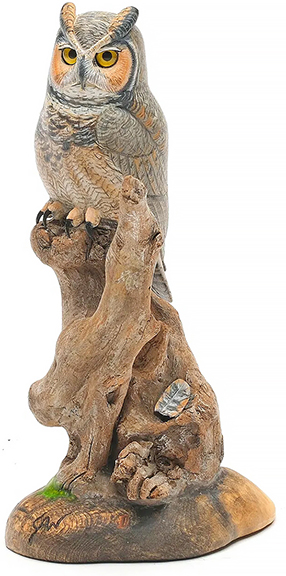
This miniature great horned owl by contemporary carver Steve Weaver (b. 1950) is only 8" tall and its final price was $7200 (est. $3000/5000). He has been carving for more than 40 years, working in a studio in Sandwich, Massachusetts.
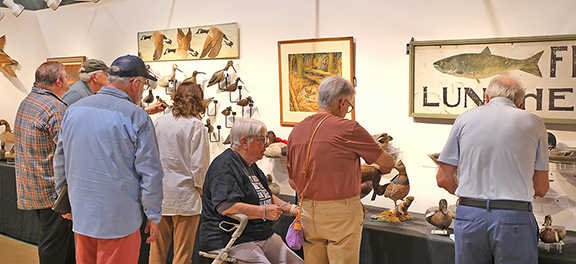
Prospective buyers examining and discussing some of the offerings.
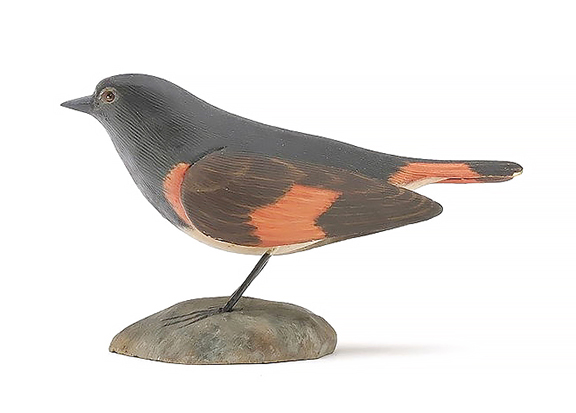
The large group of miniature carvings included several by New Hampshire’s Jess Blackstone (1909-1988). This redstart, 3¾" long, has relief-carved wings and dropped wing tips. It realized $2700 (est. $1000/1400).

Originally published in the November 2026 issue of Maine Antique Digest. © 2026 Maine Antique Digest