





















Eldred’s, East Dennis, Massachusetts
Photos courtesy Eldred’s
It was a simply splendid summer at Eldred’s Auction Gallery, East Dennis, Massachusetts, where the confluence of great collections brought stunning results.The two-day collection of Nancy and Larry Dickson alone, July 21 and 22, brought $4.78 million. The Dicksons were careful collectors who gathered meticulously. Knowing the integrity of the Dicksons’ collecting process, the new school of collectors bought freely.
Peaceable Kingdom with rhymed borders, circa 1825, by Edward Hicks (1780-1849) from the Dickson collection took top honors when it sold for $1,512,000 (includes buyer’s premium), well above the $600,000/900,000 estimate. It sold on site to Woodbury, Connecticut, dealer David Schorsch bidding for a client. Schorsch said he was very happy to acquire the picture as was his client. Schorsch told M.A.D. it wasn’t his first Peaceable Kingdom¸ but his third. Over the years he has purchased other Hicks paintings as well.
The painting is inscribed on the reverse, “Edw Hicks painter for his dear coursin [sic] Mary W. Hicks, New York,” and stamped for the canvas maker Sam Conrad. The inscription is no longer visible, but it was photographed before professional conservation by Carolyn and Sheldon Keck in October 1964. It was examined in 2012 by Yost Conservation, which revealed the fine restoration by the Kecks and concluded that no further treatment was needed. In 1826 a substantially similar painting was sent to “Dear Cousin Sarah.”
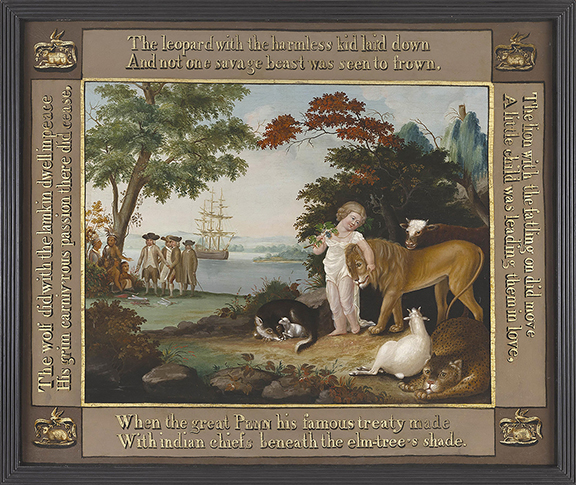
Peaceable Kingdom with rhymed borders, circa 1825, by Edward Hicks (1780-1849), from the Dickson collection, took top honors when it sold for $1,512,000 (est. $600,000/900,000).
The “auction record price” for a Peaceable Kingdom is $9,673,000, which was the bid for The Peaceable Kingdom with the Leopard of Serenity, ex-Ralph Esmerian, at Sotheby’s on May 22, 2008, in an American paintings sale. It had been offered by Sotheby’s in a private sale but failed to sell. The reported asking price was $10,000,000.
The successful bidder, Halsey Minor, did not pay for it, claiming that Sotheby’s never revealed to him or in the auction catalog that Sotheby’s had an interest in the painting. Sotheby’s brought suit to collect the funds, and Minor countersued. The judge found that “none of Minor’s arguments have merit.” Court records reveal that on February 20, 2010, Sotheby’s resold Peaceable Kingdom with the Leopard of Serenity for $7,000,000.
Over the course of the last 30 years of his life, between 1820 and 1849, Hicks, the Quaker minister who trained as an ornamental sign painter, created more than 62 versions of Peaceable Kingdom, his allegory of the harmony of the spiritual and earthly. He was influenced by a rift of the time between various groups in the Quaker community. He added symbols of Quaker belief and Pennsylvania history such as the enactment of the treaty between William Penn and the Lenape. Most versions of the painting are held by public collections or are in private collections slated for institutional accession.
The present example is one of the last great examples still in private hands. The painting descended in the artist’s family until it sold to Eddy Nicholson of Hampton, New Hampshire. It passed from Hicks’s cousin Mary W. Hicks who married Edward Lawrence of Lawrence, Long Island, New York; to his great-granddaughter Hortense Howland Dixon; to her granddaughter Penelope Dixon Randolph of Manchester, Massachusetts; to Eddy Nicholson, December 12, 1986; to Marguerite Riordan, to Nancy and Larry Dickson. Riordan had offered the painting at the 1991 Winter Antiques Show for $1.3 million but sold it for less than the asking price.
It was exhibited at Andrew Crispo Gallery, New York City, in Edward Hicks: A Gentle Spirit, May 16-June 28, 1975; and at the Museum of Fine Arts, Boston, in 1980. It has also been published widely. Images are drawn from the Biblical prophecy of Isaiah, which Hicks has hand-lettered on the borders of the painting. A wolf and a lamb snuggle together; the leopard and goat are at ease in each other’s company; and the placid cow stands beside the loving, respectful lion, which acts as a tame guardian for the child, the center of it all. The same seven figures are seen in early versions of the painting, with many more added in later years.
American folk art specialist Emily C. Esser described the current painting, “In subject matter, technique, and condition, it is one of the finest Kingdoms to ever come available for sale.” Hicks’s surviving account books make no mention of his Kingdom paintings; he gave them as gifts.
For information, check the website (www.eldreds.com) or call (508) 385-3116.
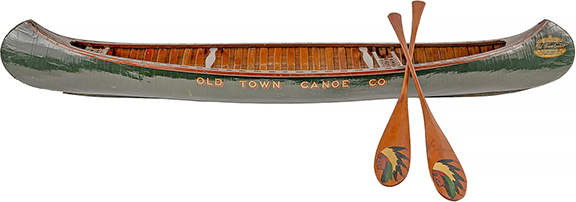
A salesman’s sample canoe, 48" long, was made by the Old Town Canoe Co., Old Town, Maine, in green painted canvas over a wood frame with standard company lettering and the company decals on both sides of the hull. The craft, an exact replica of the full-size examples, has the thwarts and woven cane bow and stern seats and retains the original “Sales Sample” label. The lot includes a pair of miniature wooden paddles painted with the head of a Native American that were not issued with the canoe and are not to scale. Estimated at $10,000/15,000, the canoe brought $63,000. According to Old Town Canoe records, 110 of these sample canoes were built and distributed to wholesalers who purchased a railroad car of full-size canoes. The samples were meant for use in store windows or other displays. Provenance includes John Rinaldi Nautical Antiques, Kennebunkport, Maine, to the Dickson collection.
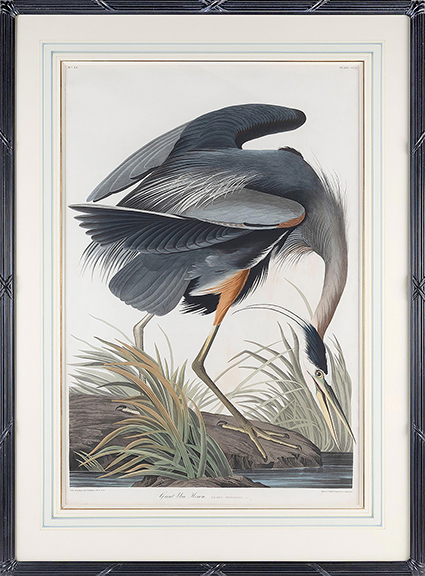
Great Blue Heron, 1834, a hand-colored engraving, 37" x 24¼" (sheet size), with aquatint after John James Audubon (1785-1851) was plate CCXI from The Birds of America, engraved by Havell of London on paper with a J. Whatman Turkey Mill watermark. Estimated at $40,000/70,000, the engraving sold for $163,800. Provenance includes Grace Phillips Johnson, New Castle, Pennsylvania; to Christie’s, 1976; to Don Didier, New Orleans; to Glenn C. Couvillion, Santa Barbara, California; to Rob Hicklin, Spartanburg, South Carolina; to the collection of Nancy and Larry Dickson.
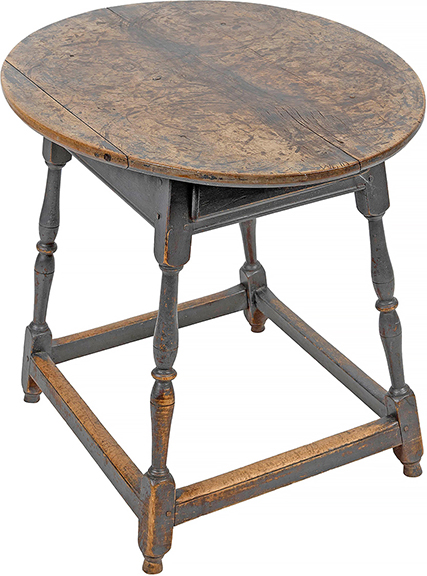
Circa 1730 New England maple and figured maple tavern table with older, possibly original, reddish-brown walnut stain under later blue-gray paint, two-board top, apron with canted sides matching the angle of the splayed turned legs, and single drawer. Measuring 26" x 30¼" x 23", it sold for $32,750 (est. $5000/10,000).
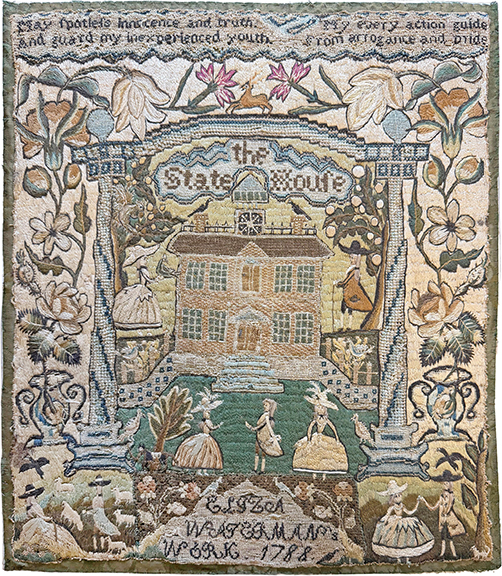
Eliza Waterman (1777-1870) was 11 years old in 1788 when she worked a sampler featuring the Old (Rhode Island) State House amid a columned arch and surrounded by dancing couples, floral vines, sheep, birds, a tiny black horse, and figures, all of whom have real hair. Such scenes were often seen in work by students at Mary Balch’s school. It was worked in lustrous silk on a linen ground, using a wide variety of stitches. There is no alphabet or range of numbers; instead, Eliza stitched a verse in the upper panel, “May spotless innocence and truth, My every action guide, And guide my inexperienced youth from arrogance and pride.” A panel at the lower margin reads, “Eliza Waterman’s Work, 1788.” The sampler was estimated at $80,000/120,000 and sold for $214,200. It descended in the Waterman family until January 1987 when it sold at Sotheby’s for $192,500 to Marguerite Riordan, of Stonington, Connecticut, from whom it entered the collection of Nancy and Larry Dickson. It was on view at the Rhode Island Historical Society from November 1983 through January 22, 1984, in Let Virtue Be a Guide to Thee; Needlework for the Education of Rhode Island Women, 1730-1830. It was also exhibited at the Museum of Fine Arts, Houston, February 1984 through May 1984; and at the Metropolitan Museum of Art, New York City, July 1984 through September 1984.
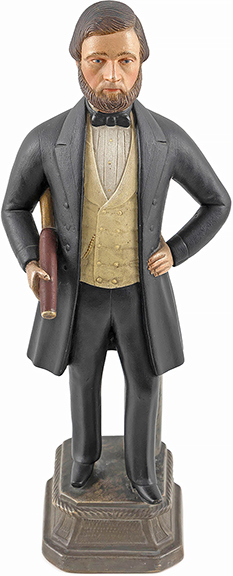
A circa 1858 carved and painted 17" stone figure of ship captain J.H. Dawes, probably Malta, sold for $50,400 (est. $15,000/25,000). Dawes (1826-1905) was master and majority owner of the 321-ton bark Sicilian of Kingston, Massachusetts. The figure is engraved on the reverse “Capt’n J.H. Dawes. Malta Feby 1st, 1858.” Provenance includes Philip Budrose via Roger Bacon; Bertram K. and Nina Fletcher Little; sold at the Little Collection sale at Sotheby’s on January 29, 1994, for $7475; Leo Landry; J. Welles Henderson; Northeast Auctions, August 16-17, 2008, to Nancy and Larry Dickson.

This rare bushel-size late 19th-century Nantucket Lightship basket is attributed to Captain Davis Hall, and measures 11½" high with a diameter of 19½". Estimated at $3000/5000, it sold for $25,200. It’s published in The Decorative Arts and Crafts of Nantucket by Charles H. and Mary Grace Carpenter (1987), Nantucket Lightship Baskets by Katherine and Edgar Seeler (1982), and The Lightship Baskets of Nantucket, A Continuing Craft. Captain Hall (1825-1905) was born in Hanson, Massachusetts, and grew up without knowing his mariner father, who died shortly after Davis was born. His family moved to Nantucket after his mother remarried. At age 21, Hall was one of seven men who sailed the 44-ton fishing schooner Mary and Emma to California during the Gold Rush. It was the smallest vessel to sail around Cape Horn. When he returned to Nantucket, he worked for the Massachusetts Humane Society rescuing ships in distress before enlisting in the Union Army in 1862. In 1877 he was appointed to the crew of the South Shoal Lightship, where he learned the art of basket making. His baskets are known for their tight weave and beautiful symmetry.
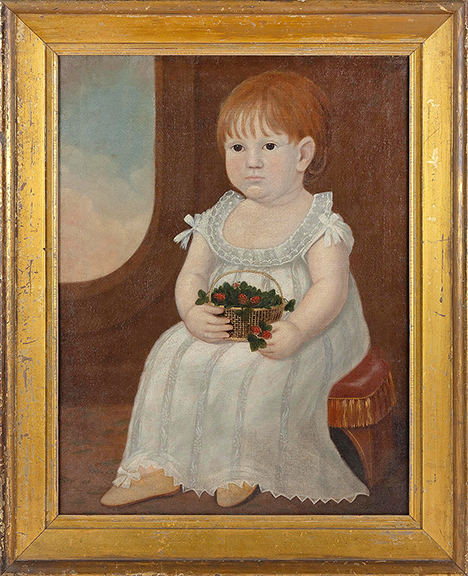
A circa 1800 American school portrait of a young girl wearing a lace-trimmed white dress, seated on an upholstered ottoman and holding a basket with strawberries, 26" x 20" (sight size), sold for $36,540 (est. $20,000/40,000). It had previously sold at Willis Henry Auctions, August 25, 1993, for $93,500 to Fred Giampietro, underbid by Thomas Colville. The Dicksons acquired it from Marguerite Riordan on February 1, 1994.
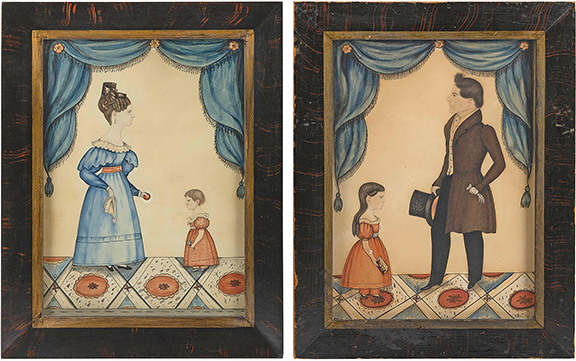
A pair of portraits of the Thompson family of Portsmouth, New Hampshire, circa 1833, includes mother Eliza Burt with daughter Caroline and father Zara with daughter Elizabeth. The sitters are pictured in matching interiors, and the pictures are inscribed faintly on the backboards, “Eliza Burt Thompson wife of Zara Thompson and daughter Caroline born Christmas Day in 1831, died Portsmouth Sept. 26, 18[?]” and “Zara Thompson and wife Eliza Burt Thompson their eldest child Elizabeth Greenough Thompson born Sept. 22, 1826. Married James Morland and died in Chicago Jan. 8, 1916.” The pictures are executed in watercolors on watermarked paper, each 10½" x 7½" and 10¾" x 7¾" (sight size). The pair sold for $189,000 (est. $12,000/18,000). Provenance includes the Arthur J. Menard collection; to Frank and Barbara Pollack, Highland Park, Illinois; from them to Don Walters in the early 1980s; from Walters to Marguerite Riordan, Stonington, Connecticut, August 1996; to the collection of Nancy and Larry Dickson. Little is known about the painter, J. Evans, including gender, while all attributions are profile portraits in watercolor with no visible pencil drawing beneath, and all appear to depict residents of the Portsmouth area. Only two signed examples have emerged to date. The work is often confused with that of the more prolific Joseph H. Davis.
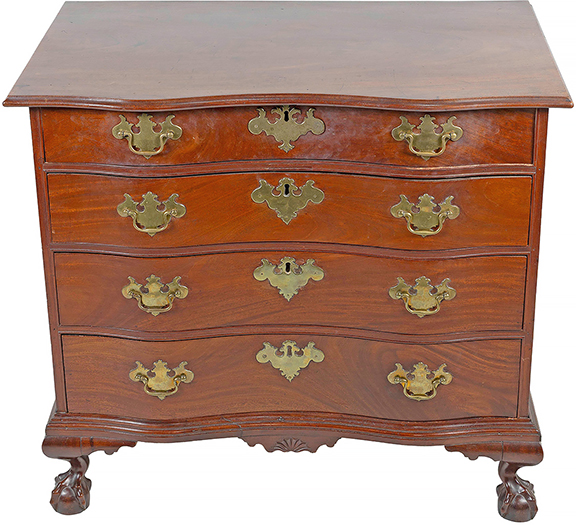
This circa 1770 Boston mahogany oxbow chest is attributed to John Cogswell and sold for $37,800 (est. $30,000/50,000). It has a one-board overhanging top with molded edge, four graduated full-width drawers with cock-bead molding, brasses and escutcheons believed to be original; a molded base with a fan-carved pendant drop, and ball-and-claw feet. The 32¾" x 36" x 20¾" chest sold at Northeast Auctions, November 5-6, 1994, for $77,000 to Wayne Pratt. The Dicksons acquired it from Marguerite Riordan on February 1, 1995. According to the catalog, John Cogswell (1738-1819) moved to Boston from nearby Ipswich, about 1760. He is particularly known for a bombé chest-on-chest that bears his signature, now in the collection of the Museum of Fine Arts, Boston.
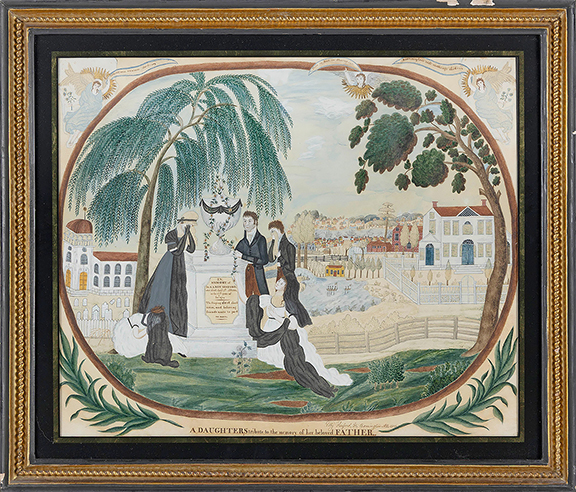
Watercolor, ink, gold, and mica on paper, memorial, 16" x 19½" (sight size), titled A Daughters Tribute to the Memory of her Beloved Father, featuring five figures, the monument inscribed “In Memory of Dr. A. Aaron Hosford, who died April 7th AD 1804, in the 57th year of his age. The sleeping dust shall arise, and believing friends unite to part no more,” angels with banners in the upper margins read “Christ our ransom died,” “There is rest in Heaven,” and “Redeeming love soft soft soothings shed,” inscribed “Etty Hosford, Gt. Barrington, A.D. 1810,” sold for $53,550 (est. $5000/10,000). It was attributed by Betty Ring to a school in western Massachusetts, name unknown. Copies of her August 27, 1996, and February 10, 1997, letters to Marguerite Riordan discussing the attribution were included with the lot.
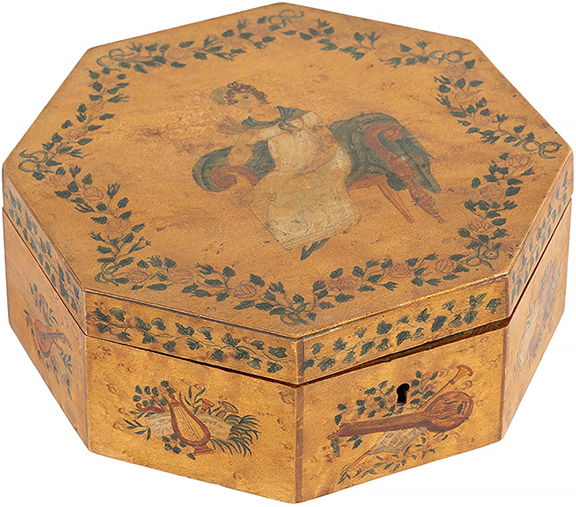
An early 19th-century octagonal bird’s-eye maple sewing box, likely Massachusetts, was possibly made at the Seymour shop in Boston and decorated by Mary Jane Appleton of Boston. The hinged top is decorated with a seated woman holding a fan amid a garland of flowers; the lip is decorated with a related ivy vine, except where it is signed “Mary J Appleton.” Each of eight panels is decorated with a musical element. The lid interior is decorated with a scene of a body of water, with a fisherman, two people rowing a boat, and a sailboat underway, with buildings and a tower on the opposite shore. One of the buildings may be the school Appleton attended in Keene, New Hampshire. The box is fitted with compartments lined in pink paper and contents include two small boxes, a miniature copy of the American Tract Society book Dew-Drops, and a penciled note revealing the box was decorated in 1822 by Appleton, who at 16, was at school in Keene, and who later married Dr. Samuel Plaisted. The box, 3" x 7¾", was estimated at $2000/3000 and sold for an impressive $113,400. It was found in Waterville, Maine. Provenance includes Kaja Veilleux of Newcastle, Maine, before it entered the Dickson collection.
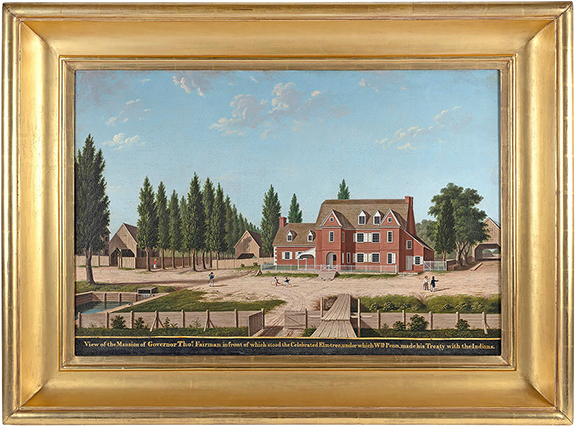
Attributed to Pennsylvania artist John Archibald Woodside, Sr. (1781-1852), View of the Mansion of Governor Thomas Fairman, inscribed “View of the Mansion of Governor Thos. Fairman, in front of which stood the Celebrated Elm-tree, under which Wm. Penn made his Treaty with the Indians,” 24½" x 35½" (sight size), sold for $40,950 (est. $40,000/60,000). Provenance includes Hirschl & Adler and Marguerite Riordan. The catalog noted that contrary to the inscription on the painting, Fairman (d. 1714) never served as governor of Pennsylvania, although he was the acting governor of the Province of Pennsylvania for a short time while the appointed governor traveled. He was mostly known for his role as deputy surveyor of Philadelphia County from 1682 to 1713, during which he received numerous important warrants to lay out land. Fairman was a Quaker and his home was regularly used as a Quaker meeting house. The mansion was built in 1702 on the banks of the Delaware River in what is now the Kensington section of Philadelphia. It was also the home of many notable Pennsylvanians, including Governors Evans and Palmer, and so it became known as the “Governor’s House.” It was demolished in 1825.
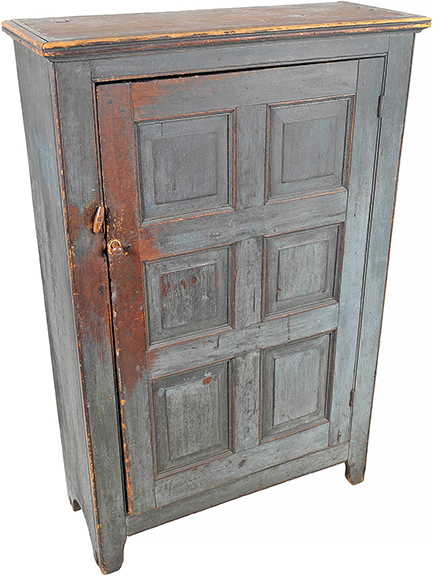
A Pennsylvania painted pine cupboard, possibly from Bucks County, circa 1820, retains much of its blue paint, revealing traces of a deep red-brown stain beneath. Below a molded cornice, the paneled door opens to three shelves. Measuring 54½" x 35¾" x 14½", the cupboard, with an estimate $1500/2500, realized $22,680. Provenance includes James and Nancy Antiques, Bailey Island, Maine, to the collection of Nancy and Larry Dickson.
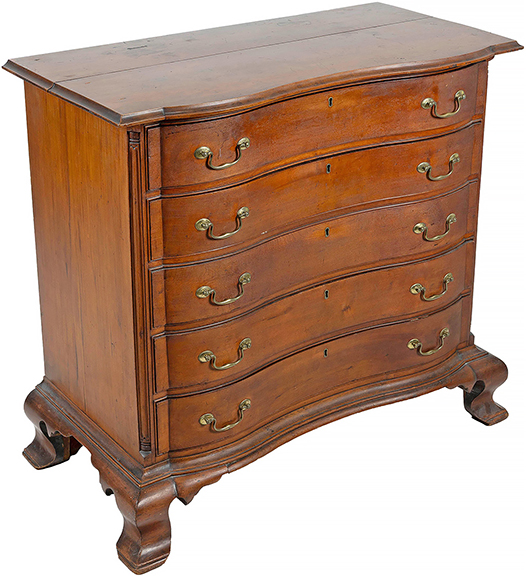
Probably from the Colchester, Connecticut area, this circa 1800 cherry reverse-serpentine chest of drawers, 38" x 40" x 20" with a two-board overhanging top with molded edge, five reverse-serpentine drawers with blocking at both ends and cock-bead molding, molded quarter columns, and ogee bracket feet sold for $20,160 (est. $7000/10,000). Provenance includes Charles Bulkeley (1752-1824), of Colchester, Connecticut; to Betsy Bulkeley (1772-1847), of Colchester, Connecticut, and Monroe, Michigan; William Addison Noble (1819-1887), of Williamstown, Massachusetts, and Monroe, Michigan; Mason Addison Noble (1852-1908), of Monroe, Michigan; Lawrence Mason Noble (b. 1903), of Stonington, Connecticut; and Nathan Liverant and Son, of Colchester, Connecticut, 1984. At the time the chest was purchased from the Noble family, Louise S. Noble provided a handwritten family provenance, which accompanies the lot. She noted “This chest remained in the old Noble family house on Front St. in Monroe from 1833 when the Noble family left Williamstown until sometime in the 1940’s when my husband inherited it [...].”
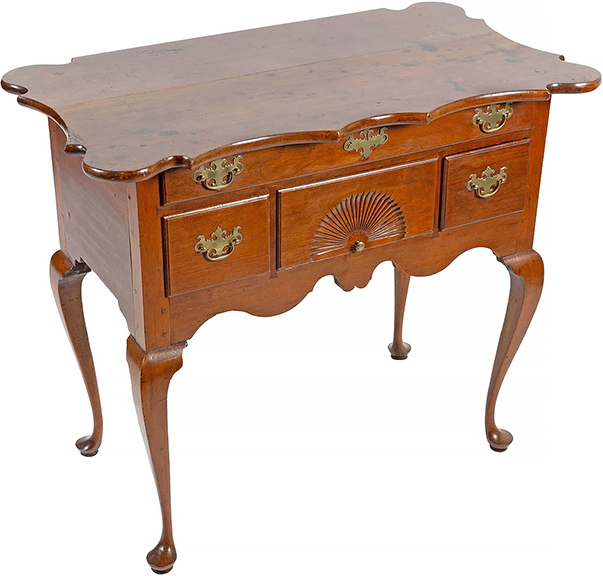
This Connecticut Queen Anne cherry dressing table with a scalloped top from the Wethersfield area is rare and important. It was made around 1750 with out-rounded corners, scalloped on three sides, with a full width drawer over three smaller drawers, the central one with a carved fan, and a scrolled apron. It exhibits traits associated with the Wethersfield school: the fluidity of the skirt, the carved fan style, canted knee brackets, and truncated pads on the feet. It was estimated at $25,000/50,000 and realized $189,000. The table was discovered in Clinton, Connecticut, in 1945 by Betty H. Richmond and her husband; a letter from Mrs. Richmond on the letterhead of William’s Antique Shop in Old Greenwich, described how she and her husband discovered the piece. It sold at Christie’s Americana sale, January 23, 1988, to John Walton, Inc. for $82,500; then to the collection of Thomas and Alice Kugelman of Hartford; to Marguerite Riordan, of Stonington, 1999; to the collection of Nancy and Larry Dickson. The table was published in Connecticut Furniture: Seventeenth and Eighteenth Centuries by Henry P. Maynard (1967).
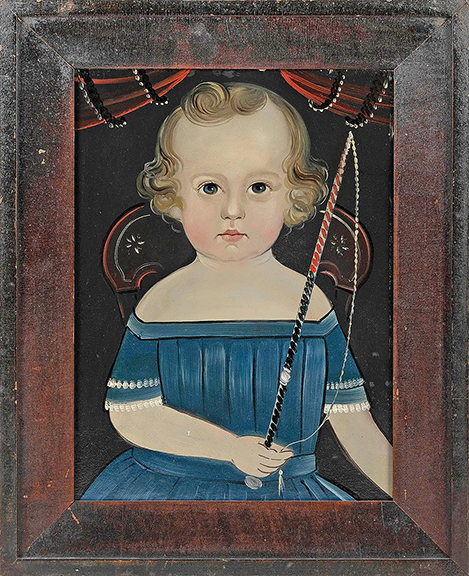
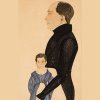
Portrait of a young boy in a blue dress attributed to Sturtevant J. Hamblin (1817-1884), 14" x 10" (sight size), sold for $47,250 (est. $5000/10,000). Ex-Marguerite Riordan, it sold on September 27, 1993, to Nancy and Larry Dickson.
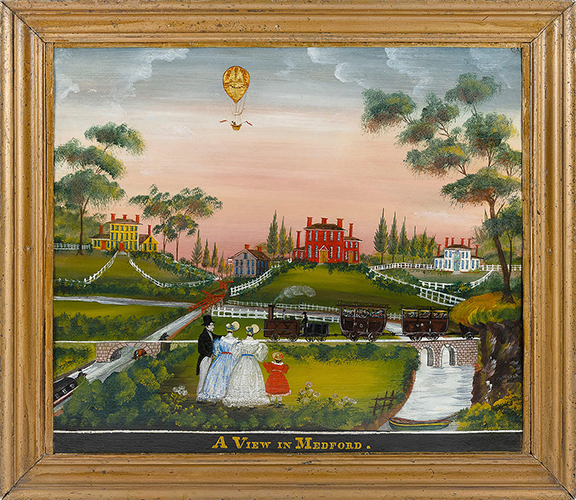
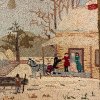
A View in Medford depicts the daily events in Medford, Massachusetts, around 1830. Four figures take in the view. A horse, or two, pulls a canal boat along the Middlesex Canal toward an upstream lock; the Medford Pond flows into the Mystic River; a train continues its journey along the tracks; four buildings are set in the background as a hot air balloon floats above the scene. The scene is a catalog of the transportation of the era. The American school oil on panel, 19½" x 22½" (sight size), in the original frame, was likely made by the artist. In exceptional condition and estimated at $70,000/100,000, the painting brought $138,600. The Dicksons acquired the painting from Marguerite Riordan of Stonington, Connecticut. A View in Medford has been published extensively; it was discussed and illustrated in American Fancy: Exuberance in the Arts, 1790-1840 by Sumpter Priddy III (2009). It is likely to have been discussed in The Medford Historical Register, March, 1923. A similar work, The Junction Formed in Medford by the Meeting of the [Mystic] River, Canal and Railroad sold at Skinner, Inc., in 2013. An attached note indicates that it was painted in 1835 and descended in the Brooks Wheeler families.
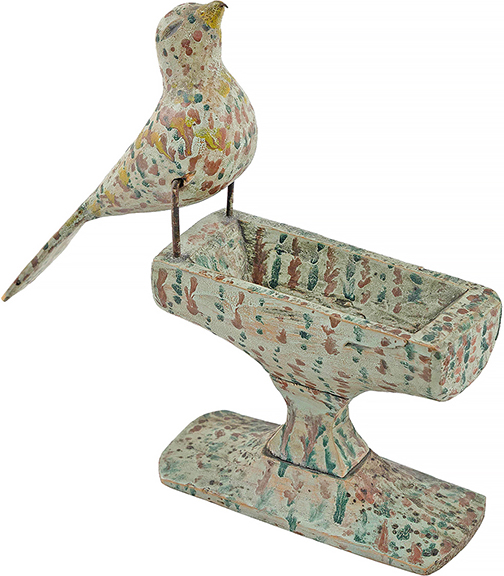
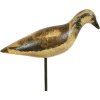
A late 19th- or early 20th-century carved and painted softwood birdbath with a nearly life-size songbird with metal legs and a tiny metal worm in its beak is perched on a diminutive pedestal basin. The bath, in green, red, and yellow speckled paint on the gray-green ground, stands 8" tall. Estimated at $200/400, it brought $5355. It entered the collection of Nancy and Larry Dickson from Ed Weissman Antiquarian, Portsmouth, New Hampshire, February 14, 1989.
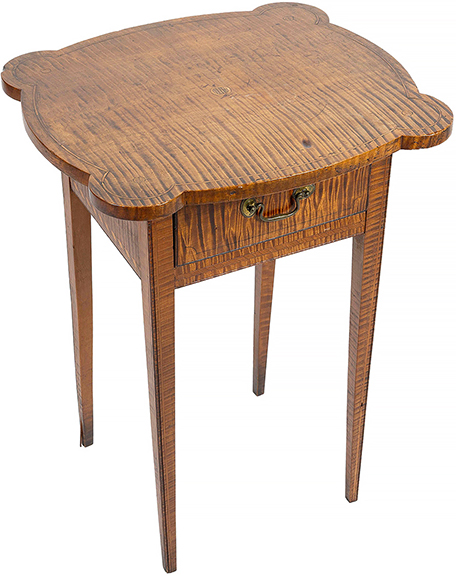
An unusual highly figured maple table, New England, circa 1800, with shaped overhanging top with line inlay along the perimeter and coin inlay at the center and at each of the out-rounded corners. The single drawer is painted to simulate cut-corner line inlay. Measuring 27" x 20" 17½", it sold for $27,720 (est. $4000/6000). Provenance includes Alexander Acevedo. A similar example, if not this exact table, is illustrated in Fine Points of Furniture: Early American by Albert Sack (1950) as a “best” example.
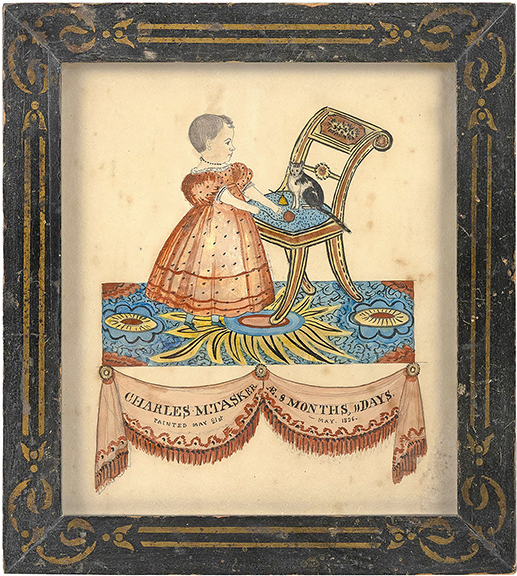
Watercolor portrait of a young Charles M. Tasker by Joseph H. Davis (1811-1865), 7" x 6 1/8" (sight size), conserved in October 1994, ex-Marguerite Riordan, sold for $53,550 (est. $12,000/18,000). Tasker is depicted standing next to a Federal chair and offering a ball of yarn to his cat. The inscription reads “Charles M. Tasker Painted May 21st Æ 8 Months, 11 Days—May, 1836.” Davis is known to have painted at least four members of the Tasker family of New Hampshire, including the Reverend Levi B. Tasker, his wife, Hannah, and their children, Charles M. and Lydia Ann.
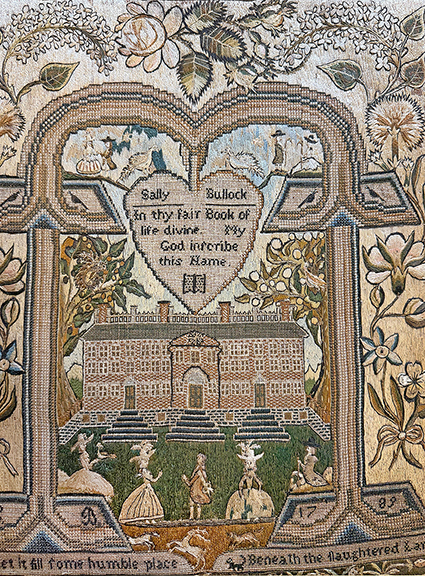
This needlework sampler was dated 1789 by Sally Bullock of Providence, Rhode Island, and inscribed within a heart, “Sally Bullock In the fair Book of life divine My God inscribe this Name.” The heart is suspended from an arch framing a view of the College Edifice, the first building on the campus of Brown University, constructed in 1770. The needlework, 16¼" x 13¼" (sight size), is rich in detail with figures: a squirrel, a bird in a blossoming tree, and a pair of wild turkeys, and a dog in pursuit of a stag. The College Edifice was a popular subject in samplers made at Mary Balch’s school as were elegant clothing, floral borders, a pseudo-Classical arch, and a public building, all seen in this sampler. It was worked in silk on linen ground, with real blonde hair on some figures. The College Edifice, on the Brown University campus was renamed University Hall in 1823 and still stands. Sally Bullock’s sampler sold for $88,200 (est. $50,000/80,000). The needlework sold for $110,000 in June 1987 at Sotheby’s and was acquired by Marguerite Riordan who sold it to Nancy and Larry Dickson in 1992. It was published in “A Stitch in Time: Rare Treasures of American Needlework” by Marguerite Riordan, in Art and Auction, January 1988.

Originally published in the November 2026 issue of Maine Antique Digest. © 2026 Maine Antique Digest