



























"Sometimes one tiny detail can unlock the history of an antique,” said Jason Iorio of Willow Auction House, Lincoln Park, New Jersey, on Instagram a few days before the September 10 auction, where he sold a Massachusetts high chest attributed to Eliakim Smith (1735-1775) for $100,000 (includes buyer’s premium).
Standing in front of the bonnet-top highboy, Iorio told viewers, “When we first came across this Queen Anne highboy, we knew there was something special about it…the clue was the distinctive carved vines. That is what identified it as the work of Eliakim Smith, an 18th-century cabinetmaker who worked in the Hadley-Springfield area of Massachusetts. Sometimes, all it takes is one small detail to uncover a much bigger story.”
Iorio told his 9400 Instagram followers that “after some digging,” he found a related example in the Historic Deerfield collection.
Historic Deerfield had Leigh Keno do its bidding when it acquired a highboy attributed to Eliakim Smith at Sotheby’s in January 1994, for $162,000. Thomas and Alice Kugelman and Robert Lionetti cast doubt on the Smith attribution for Deerfield’s chest in their book Connecticut Valley Furniture: Eliphalet Chapin and His Contemporaries, 1750-1800 (2005) noting that Smith “conceivably could have made it near the end of his short career” but the “bonnet-top high chest more likely was produced a decade or more after his demise.”
Iorio said he did not change his lowball $600/800 estimate because the finish was sun bleached from spending years in a sunny room in an Upper East Side apartment and there were some chips and other evidence of age. It was not ignored by the trade.
The Instagram post and alerts from online auction platforms told the world about Iorio’s discovery. Iorio said three dealers stayed in the bidding until he knocked it down to one of two phone bidders; the underbidder was online. Iorio will not reveal the buyer’s name but said he was a member of the trade.
Philip Zea’s article, “Diversity and Regionalism in Rural New England Furniture” in Chipstone Foundation’s 1995 edition of American Furniture, and Christie’s catalog essay for the October 8, 1997, sale of the similar Hawley-Clarke-Lyman family high chest, cataloged as “School of Eliakim Smith” and sold to Wayne Pratt for $156,500, attest to the high quality work of a master cabinetmaker in the Connecticut River Valley.
Wayne Pratt then took it to the Delaware Antiques Show in November 1997, and asked $245,000 for it. The same high chest came up again at Sotheby’s January 17 and 18, 2002, auction, where it sold for $214,750 to a phone bidder, who was underbid by Leigh Keno. Its provenance includes Ginsburg and Levy; pianist Vladimir Horowitz; Good & Hutchinson Associates; Wayne Pratt; and a private collector.
Two high chests with similar carved vines, both cataloged without a Smith attribution, have crossed the auction block. One sold at Sotheby’s on January 20-22, 2006, for $66,000, and another at CRN Auctions on November 6, 2016, went for $13,200 to a collector.
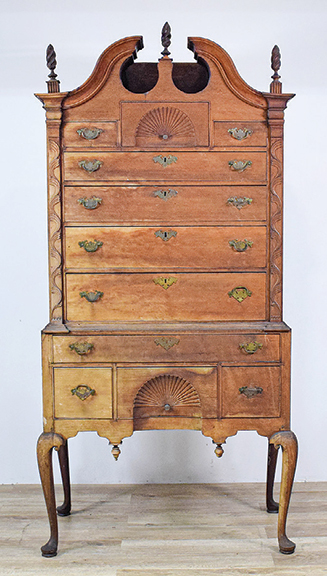
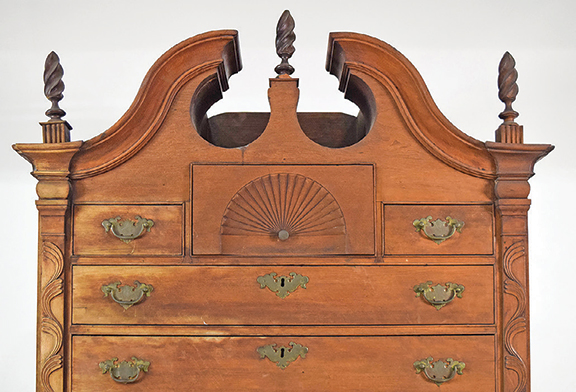
Queen Anne cherrywood high chest of drawers with vine-carved pilasters, attributed to Eliakim Smith (1735-1775) of Hadley, Massachusetts, 84" x 39" x 20", sold to the trade for $100,000. The undulating vine motif is seen on gravestones, doorways, embroidered textiles, and carved oak chests made in the 17th and early 18th centuries in the Hadley region, according to Historic Deerfield’s cataloging. The Deerfield example is the most sophisticated; its vine carving has a stippled background and the upper drawer facades are sawn to conform to the pediment. Philip Zea believes there are two groups of case furniture with applied pilasters; one made in the Springfield area and the other around Hadley. Years after Deerfield acquired their high chest, he saw a breakfast table in a house in Hadley that had flutes on its legs similar to the flutes at the bottom of the applied pilasters on the Deerfield high chest and the Willow Auction House high chest. Both could, or could not, be the work of Eliakim Smith in the 1770s. Willow Auction House photos.
According to the Christie’s catalog for the Hawley-Clarke-Lyman high chest, “similar vine-carved pilasters adorn approximately twelve related high chests and desk-and-bookcases that together, comprise a school of cabinetmaking that flourished in the Hadley-Springfield area during the mid- to late-eighteenth century.”
Eliakim Smith was born in Suffield, Connecticut, and had moved to Hadley, Massachusetts, by 1750. There, he catered to the local elite. He served as captain of a regiment in the first few months of the Revolutionary War and died at the army camp in Watertown, Massachusetts, in 1775, after fighting in the Siege of Boston.
According to Zea’s article in American Furniture, Smith’s furniture was made with Boston/Salem proportions and construction details, but governed by a provincial aesthetic that permeated New England through most of the 18th century in which “the rural baroque design of shells and the regional preference for vines demonstrates the marriage of skills, materials, and intent that hybridized all that had gone before to create something new.” The Deerfield chest was bequeathed by Oliver Smith (1766-1845) of Hatfield to his niece Sophia Smith (1796-1870), founder of Smith College.
For more information, email [email protected], check the website (www.willowauctionhouse.com), or call Willow Auction House (862) 895-5700.

Originally published in the November 2026 issue of Maine Antique Digest. © 2026 Maine Antique Digest